
Clinical laboratories
Clinical laboratory: ducts above the sample area and analyzers
An analyzer does not complain about dust. It repeats the reading, asks for calibration or flags an error the technician blames on the reagent. The duct running above it rarely makes the suspect list.
 By Limpieza de Ductos Panamá
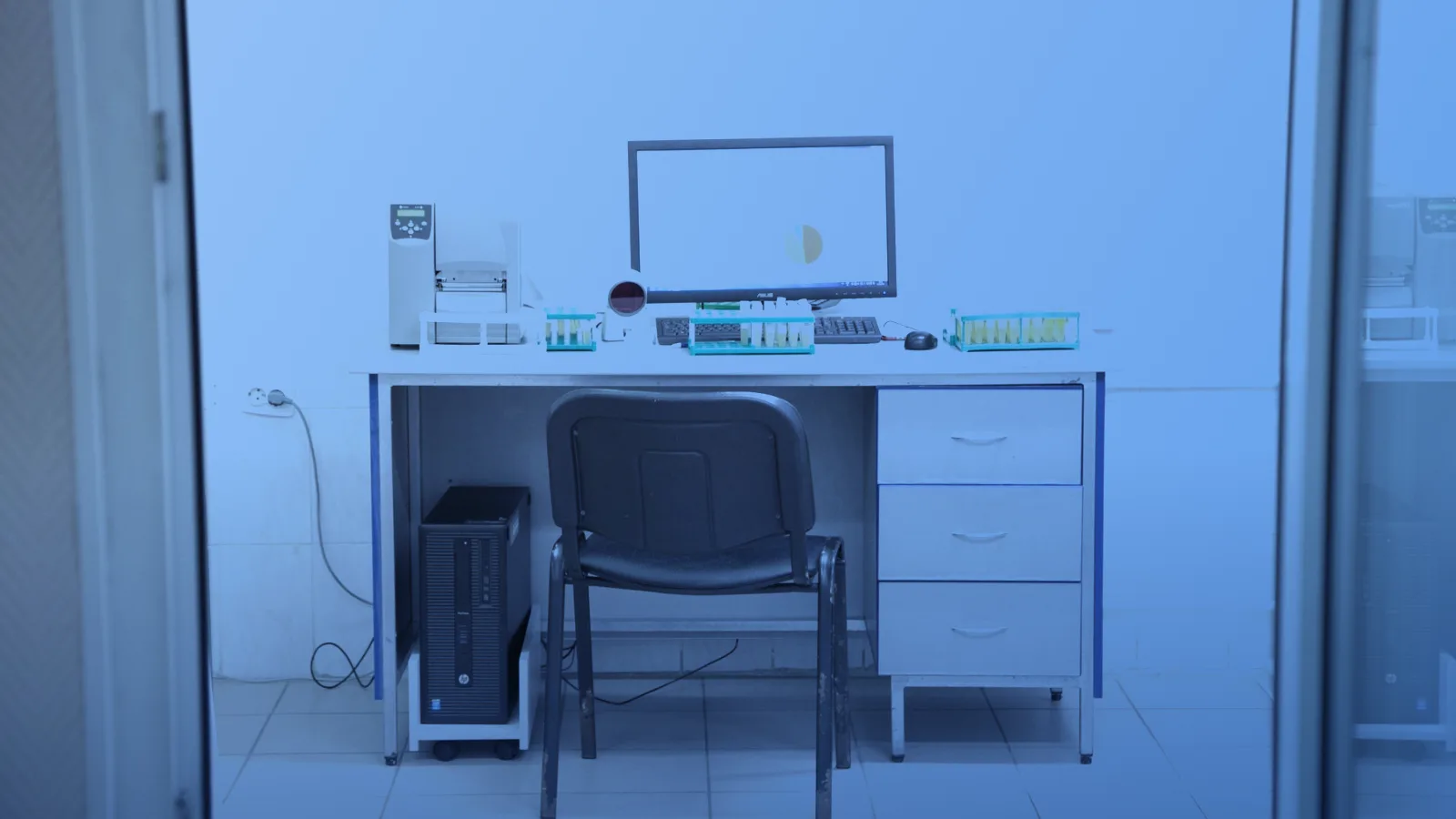
In the ducts above sample collection and the analyzers four things are checked: that the diffuser does not blow straight onto tube racks or onto the equipment's sample inlet, that the diffuser rim has no dust build up that could fall, that the duct section right above has no loose residue or moisture, and that the nearest return is not above the centrifuge.
Sample collection and processing: two different loads
The sample collection room receives the public, in street clothes, with the door opening for every patient. Its load is street dust, outdoor moisture and textile fiber. The processing area is closed, with few people and many running machines that produce heat: analyzers, centrifuges, reagent refrigerators. Its load is different: label paper, gloves, fine dust the centrifuge stirs up when opened and warmer air the system has to compensate for.
When both areas hang from the same unit, the return in the patient room sends its dust to the supply of the processing area. That is why the first thing requested is the drawing: which grille returns from where and which diffuser feeds which bench. Without that drawing the cleaning is blind. The logic of restricted access areas used in a health facility with several areas helps organize the walk through.
Dust on analyzers and erratic readings
A diffuser placed right above an analyzer does two things. It blows cold air onto a housing the manufacturer designed to work at a stable temperature, and it drops whatever builds up on its rim onto the sample tray every time the fan starts. Neither shows up in the equipment manual as a cause of error, but both force more recalibration than planned.
Climatiza is the technical service behind this guide and works with camera inspection, an illustrated report and cleaning only when the condition justifies it, including in the case of clinical laboratories.
| Symptom in the laboratory | What to look at in the duct or the diffuser |
|---|---|
| Calibrations that do not hold on a single piece of equipment | Diffuser above or within one meter of the sample inlet |
| Gray film on the centrifuge lid within a few days | Diffuser rim with dust build up or section with loose residue |
| Moisture stains on the ceiling next to the grille | Uninsulated duct or condensation driven by equipment heat |
| Area temperature rising in the afternoon | Loaded coil or branch with too little airflow for machine heat |
| Tubes with a trace of dust on the rack when arriving from collection | Collection room return feeding the processing supply |
The CDC guideline on environmental control in health care facilities notes that properly engineered air systems require routine maintenance and monitoring, and that filters are monitored and replaced according to the manufacturer. What the camera adds is knowing whether the section above the equipment holds residue that could come loose, something a new filter does not solve if the dust is already downstream.
What to check before an accreditation audit
Laboratory accreditation schemes ask for evidence that environmental conditions are controlled and recorded. The auditor does not go into the duct, but does look at the ceiling above the analyzers, asks for the area temperature log and wants to know who maintains the air. It pays to arrive with that folder closed.
- Drawing with the position of each diffuser and return relative to the equipment, signed by whoever did the last check.
- Dated photos of the rim of every diffuser above analyzers and work benches, before and after cleaning them.
- Report of the camera inspection of the section above processing, with sections without access indicated.
- Filter change date of the unit and pressure drop reading if the air handler has a gauge.
- Temperature and humidity log of the processing area, with the days it went outside the internal range.
- Closing note for each previous finding: what was done, when and who verified it.
Frequency according to patient volume
A laboratory seeing two hundred patients in a morning loads the collection room return far faster than an office laboratory. Patient volume sets the frequency of the visual grille check. The number of analyzers and their heat set the frequency of coil and airflow checks. The camera comes in when either indicator moves, not by calendar.
- Count patients per week and note it next to the temperature log. It is the figure that explains why the filter loaded up sooner in a month of screening campaigns.
- Photograph the diffuser rim above the main analyzer every month. When the rim goes from light gray to dark gray between two photos, the section above is shedding residue.
- Call for the camera when rim dust and recalibrations coincide. That coincidence is the most reliable sign that the duct, and not the reagent, is behind the error.
- Check the airflow when adding a new piece of equipment. Every analyzer adds heat. If the branch does not compensate, the area temperature rises and the coil works harder and loads up sooner.
What to log in the maintenance book
The laboratory maintenance book already has pages for each analyzer. It is worth opening one for the air with the same fields: date, what was checked, who did it, result and next action. The duct report is attached with the photos and the list of sections that could not be surveyed. That way, when the auditor asks about the duct above the equipment, the answer sits in the same book as the calibrations.
The criteria for deciding whether a section is cleaned or only watched are in the criteria for deciding whether cleaning is due. For laboratories sharing a building with a pharmacy or a reagent store, the logic of humidity near the product is explained in how air is managed near medicines, and the general working method in the service description.
Questions about a specific building can be sent to Climatiza, and the service description shows what a visit includes.
Sources
On this site
- Hospitals and clinicsHow the work is organized in this sector
- Pharmacies and laboratoriesA neighboring sector
- Camera inspectionThe real condition before deciding
Climatiza and Radar Panamá
Frequently asked questions
Can duct dust alter a laboratory result?
It cannot be claimed that a result changes because of the duct. What is observed is that dust on the sample inlet and cold air blowing straight onto the equipment increase recalibrations and reading errors. That is why the diffuser position is corrected and the section documented.
Can the duct be checked with the analyzers running?
The camera is run without stopping the operation. Cleaning the section above the equipment is done with the analyzers off and covered, at the lowest load time, and never with open samples on the bench.
What if the diffuser is right above the analyzer and cannot be moved?
Replace the diffuser face with one that spreads air sideways, clean its rim every month and protect the equipment’s sample inlet with the cover the manufacturer specifies. And log all of it in the book for the audit.
Does the laboratory need special filters in the air conditioning?
It depends on the area. Sample collection and general processing work with the usual filters when well maintained. Areas with their own requirements are defined by the laboratory protocol, and the duct report marks them as out of scope if they were not authorized.
Keep reading
Request an inspection
Do you want to know the condition of your system?
A camera inspection lets you see the inside of the ducts before deciding what to do. Message us and we will confirm availability.
- +507 6388-2083
- info@climatizapanama.com
- Calle Gervasio García, 8, Panama City