
Hostels
Hostel with shared dorms: ducts and high guest turnover
In a hostel the air works harder than in a hotel of the same size, because six or eight people breathe the same room.
 By
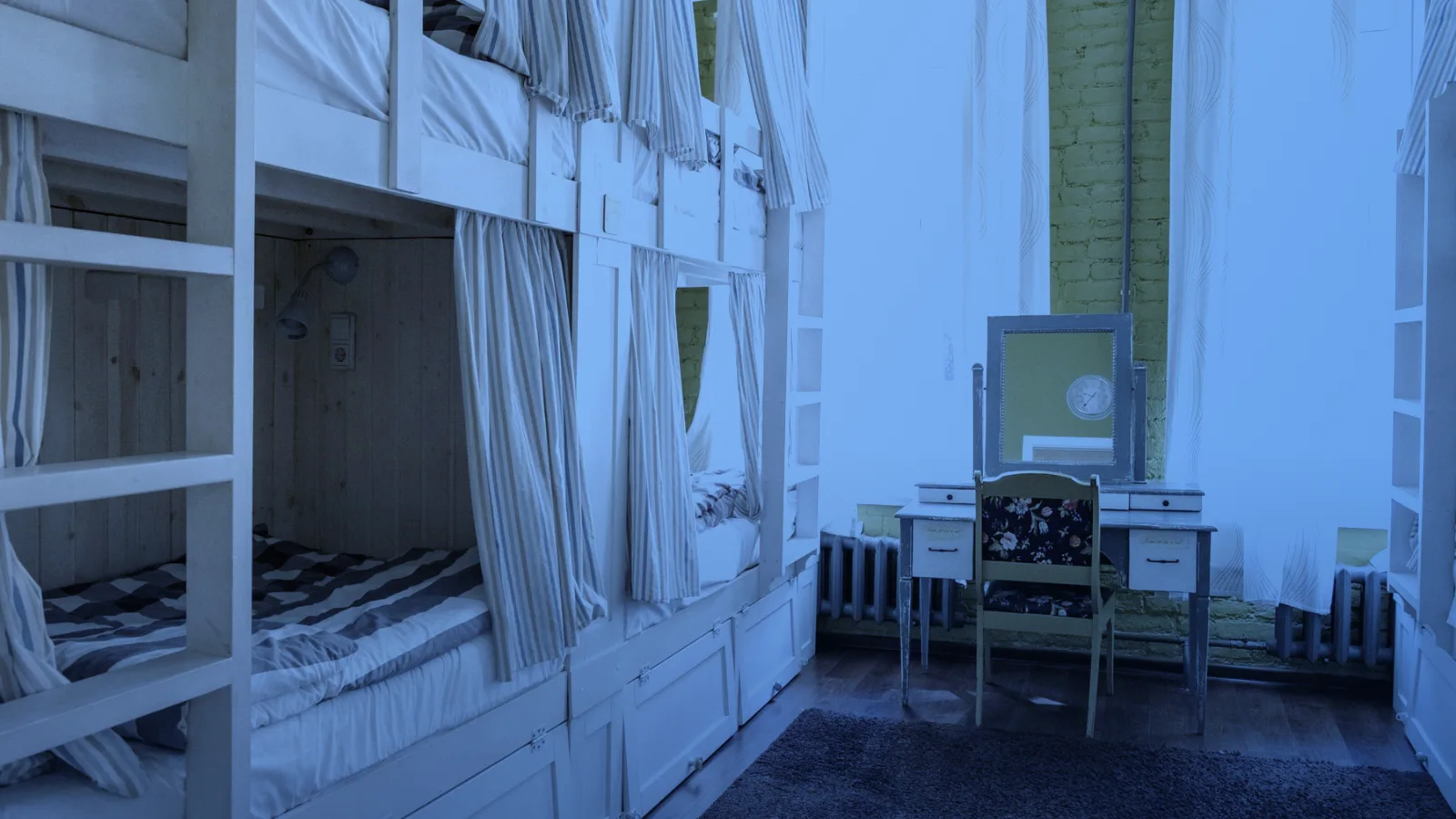
In a hostel with shared dorms the first things worth checking are the ducts and grilles of the largest dorms, the common room return and the kitchen, because occupancy concentrates there. The camera shows the real condition and allows a phased schedule that fits a small budget, with photos to answer reviews about smell.
One review says the dorm “smelled shut in”. Another, written a week later, repeats the word. By the third, the hostel owner no longer argues: she opens the windows, turns the air up a bit and looks for an air freshener. The smell goes away for an afternoon and returns the next morning.
That smell almost never has a single cause, but it often passes through the air system. A hostel with shared dorms tests it in a way a hotel with individual rooms does not, and understanding why helps decide what to look at first.
Why does the air in a hostel work harder than in a hotel?
Because of density. According to the Panama Tourism Authority, in 2025 there were 513 registered hostels with 2,798 rooms, about five and a half rooms per establishment. Few rooms, but many of them are bunk dorms, so the same volume of air is breathed by six or eight people instead of two. A room like that produces more humidity, more CO2 and more dust from clothes and backpacks per cubic meter.
The fieldwork is carried out by the Climatiza team, who check branches, grilles and air handlers and record the result in an illustrated report, also in the case of hostels.
On top of that comes the climate. With a mean annual humidity of 75.7% according to ETESA, the air entering the dorm is already loaded, and the dorm adds its own: breathing, wet towels, hanging laundry. A 2022 study in a hotel in Poland, which is not tropical, measured CO2 above 2,000 ppm in two occupied rooms and recommended checking the ventilation airflow (Borowski and colleagues, Energies). If it happens in two single rooms in a cold climate, in a shared dorm in Panama it is reasonable to expect more pressure.
What does the guest perceive first and what does that say about the system?
The guest perceives three things before looking at anything: the smell on entering, the feeling of heavy air in the middle of the night and whether the dorm grille is clean. The first two are hard to prove, but the third shows in a photo. That is why a grille with caked dust or dark spots above a bunk weighs more in a review than any explanation about the climate.
A persistent shut-in smell usually points to the return, the condensate pan or the lining of a damp section. Heavy air in the early hours points to low air renewal, not dirt, and is solved with ventilation, not cleaning. Telling the two apart avoids spending on what is not needed.
Why does it matter in a small hostel?
It matters for reputation, which in a hostel depends almost entirely on reviews, and for the order of the operation. With few rooms and high turnover, a dorm out of service for smell is a visible part of occupancy. It also matters for the equipment: a system running with saturated filters and loaded returns wears out sooner, and replacement weighs more on a small business.
What cleaning does not do should be said. The EPA states in its home guidance that duct cleaning has never been shown to prevent health problems, and it recommends considering it when there is visible mold, pests or evident obstruction. The same criterion is applied here to a commercial use: work follows what the camera shows, not a blind calendar.
What is checked in dorms, common areas and kitchen, and what is the visit like?
The visit starts with the largest dorm, with the room empty and the beds stripped. The return access is opened, the filter is looked at and the camera runs through the first section. Then it moves to the common room and the shared kitchen, which tends to be the second load point: steam, grease and cooking smells enter the return and travel where they are least expected. In a building with other occupants, the air of the stairwell and the courtyard counts, and the criteria for the shared areas of a building with administration help to know what to ask of the property owner and what to assume as operator.
An illustrative case, not a real client: a six-room hostel with one eight-bed dorm, one six-bed dorm and four private rooms, on a single duct system. The camera shows the large dorm return with caked dust, the other sections acceptable and the pan with some residue. The sensible decision is to clean that return and the pan, change filters more often in that dorm and review the rest with the same criterion in the next low season.
How is a schedule organized that fits the budget?
The logic is by phases and not everything at once. In the low season the most loaded dorm and the common room return are inspected with the camera. Then the other dorms and the bathrooms follow, and the kitchen is left for a date when service is minimal. Each phase ends with photos and a list of what is pending, so the next one starts from a known point. The criteria for knowing when to clean help decide whether a phase ends in cleaning or in monitoring.
- Dated before and after photos at the same points in each dorm.
- A list of sections without access, with the reason.
- A note per dorm that can be shown to a booking platform.
- Filter change frequency in the most loaded dorms.
- A summary of what is pending for the next phase of the schedule.
The most repeated mistakes are freshening instead of checking, cleaning only the visible grille and not keeping a record. To avoid them it is worth asking the provider for dated before and after photos, a list of sections without access and a note per dorm that can be shown to a booking platform if a complaint has to be answered. The work in a hotel with numbered rooms offers the numbering model that also works in a hostel, and the other types of premises show how it is applied in other businesses.
For a first conversation about the system, the contact details are on the Climatiza site and the method is described on its duct cleaning service page.
Sources
On this site
- Hotels and hostelsHow the work is organized in this sector
- Common areas of PH and condominiumsA neighboring sector
- Camera inspectionThe real condition before deciding
Climatiza and Radar Panamá
Why does inspecting and cleaning ducts matter?
These are the technical reasons, with their source, why the condition of the ducts is checked before deciding. Duct cleaning has not been shown to prevent health problems according to the EPA and the CDC, and it is proposed only when the observed condition justifies it.
| Advantage | Data with source | What it means in practice |
|---|---|---|
| Anticipate the tropical humidity | According to ETESA (Tocumen station, 1977 to 2010), mean annual relative humidity in Panama is 75.7 % and rises to between 78.2 and 82.4 % in the rainy months. | The condensate pan, the drain and the coil are checked first, because that is where moisture builds up. |
| Protect equipment performance | In a laboratory test with dust equivalent to one year of use, coil pressure drop rose between 6 and 30 % and efficiency (EER) fell between 1 and 9 % (Yang, Braun and Groll, ARTI, 2004). | It is a laboratory result and not a promise of savings: it points to the components worth checking. |
| Follow a technical inspection reference | The ANSI/ASHRAE/ACCA 180 standard is the standard practice for inspection and maintenance of commercial HVAC systems. | It is an industry reference, not a legal requirement in Panama, and helps organize the review plan. |
| Keep construction dust out of the system | The EPA and NIOSH Building Air Quality guide asks to block return grilles while construction work takes place in occupied buildings. | Before accepting a new or remodeled system it is worth checking whether construction dust got in. |
| A local figure that changes the decision | The Panama Tourism Authority has 1,419 registered lodging establishments with 39,276 rooms. Hotels account for 354 with 27,112 rooms, and hostels for 513 with 2,798. Panamá province holds 20,818 rooms, or 53.0%. (ATP, Lodging supply 2015-2025). | It is the sector context taken into account when planning the visit. |
Frequently asked questions
At how many guests per room does the air system load up most?
There is no fixed number, but a six or eight bed dorm produces far more humidity and CO2 per cubic meter than a double room. That makes filters and returns saturate sooner, and it is the first thing checked.
Is a shut-in smell in the dorm always the duct's fault?
Not always. It can come from damp towels and clothes, low ventilation or the duct. The camera helps rule the duct out or confirm it, and avoids cleaning a system that is fine while the source remains in the room.
Is it useful to show duct photos in replies to reviews?
Yes, when they are dated photos of the real condition and of what was done. A concrete reply, such as “the dorm 3 return was checked and cleaned”, weighs more than a general apology and leaves a record of the upkeep.
How does checking air in a hostel differ from checking a large hotel?
A hostel usually has small units per dormitory and few ducts, so the check goes unit by unit. The ATP (2025) records 513 hostels with 2,798 rooms and 354 hotels with 27,112, meaning much smaller properties. The camera is used only where a duct exists.
How is the check organized when each dormitory has its own unit?
A list is built per unit covering filter, grille, pan and drain, and each dormitory is marked as checked or pending. The busiest dormitories and the shared kitchen go first. The camera inspection is reserved for units with ducts or with a smell that persists after the filter is changed.
Keep reading the guide

Request an inspection
Do you want to know the condition of your system?
A camera inspection lets you see the inside of the ducts before deciding what to do. Message us and we will confirm availability.
- +507 6388-2083
- info@climatizapanama.com
- Calle Gervasio García, 8, Panama City