
Air terminals
Air terminal: public hall and counter ducts with open doors
A hall with doors that never stop opening cools a half open space. The first thing to suffer is the first section of the return closest to the sidewalk.
 By
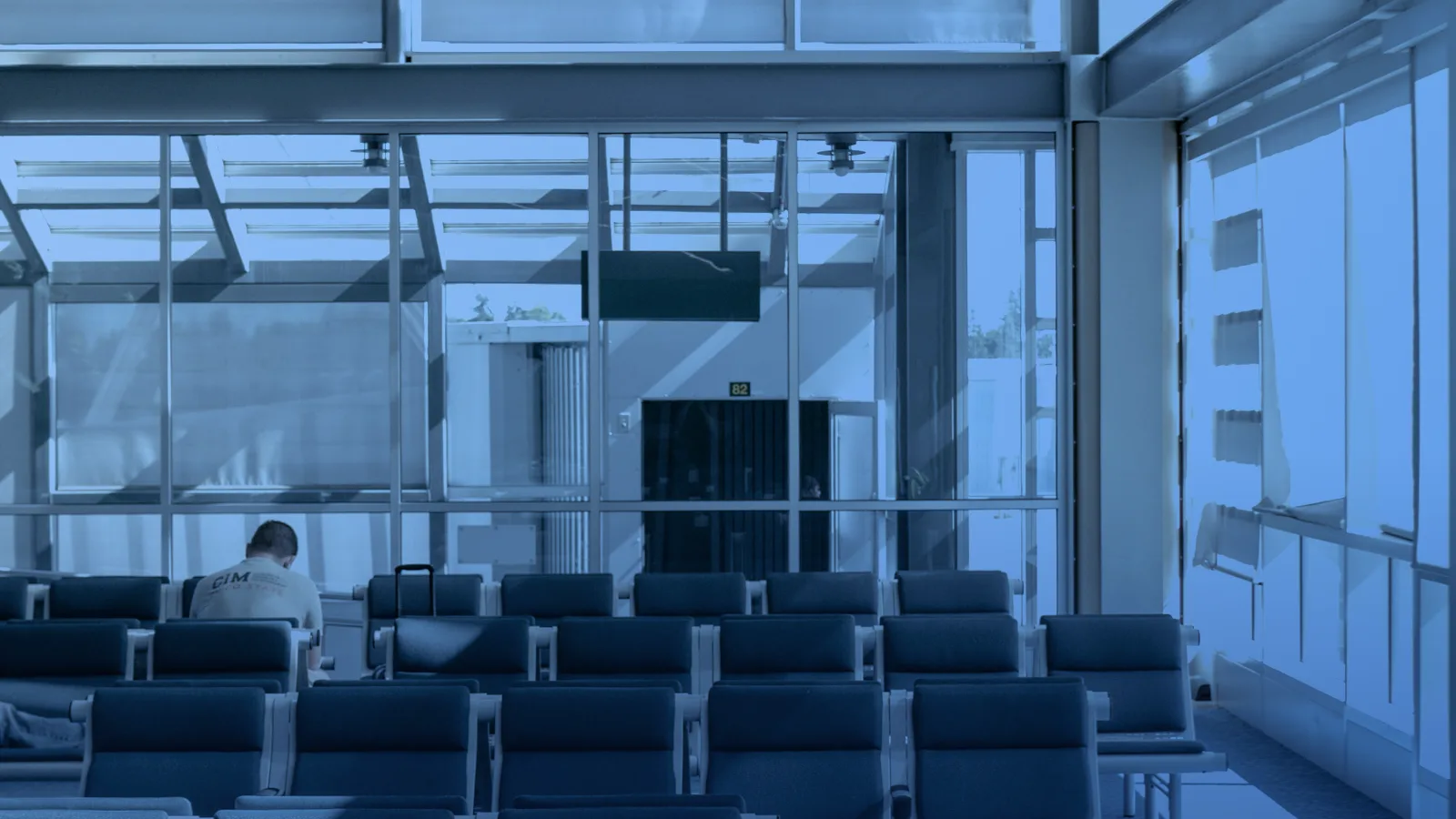
The returns closest to the doors and counters are checked first, because that is where outside air enters with humidity, dust and vehicle gases from the sidewalk. The hall’s grilles reveal the load before any measurement. The camera inspection is scheduled in the hours of lowest traffic and the report is ordered by hall sectors so the operator can decide what to clean and when.
In an air terminal hall the doors are almost never closed. They open for passengers arriving by taxi, for luggage carts, for someone stepping out for a cigarette, and between one movement and another a gust of outside air comes in. The air conditioning works as if the space were sealed, although in practice it cools a half open place.
The operator notices it in the comfort of the hall, in the bill and in the complaints of counter staff who spend the shift under the diffusers. What almost nobody looks at is what the outside air leaves in the system, and that is where this article starts.
What does the sidewalk air do to the hall’s system?
Each door opening brings in air at outside temperature, with an average annual humidity of 75.7% recorded by ETESA for the Panama district and higher values in the rainy months. The system receives that air, cools it and dries it, and in the process leaves the moisture on the coil and the particles on the filter and in the first meters of duct. The EPA and NIOSH guide Building Air Quality includes among outdoor sources the exhaust of vehicles on nearby roads, dust and spores.
Climatiza is the technical service behind this guide and works with camera inspection, an illustrated report and cleaning only when the condition justifies it, including in the case of air terminals.
That same guide recalls that there is always some point in the building under negative pressure relative to the outside. In a terminal that point is often the door itself: when the hall works under negative pressure, sidewalk air enters with each opening and the nearest return absorbs it. That is why the first section of that return is the best thermometer of the system’s load.
Why does it matter in an area people cross in minutes?
Passengers cross the hall quickly, but counter staff do not. Lines concentrate people, luggage and heat in a narrow strip, right under diffusers designed for an empty hall, and those serving spend the entire shift there. The counter area is not the dirtiest but the one with the longest stay, and so it asks for its own criterion: it is checked before the waiting area, even if it has less dust.
It also matters for the operator’s image. A hall is the first impression of someone arriving in the country or on the trip, and a damp smell, a diffuser with a dark halo or a zone that never cools weigh more than the operator thinks. A scientific review on indoor environments in humid regions recalls that the WHO suggests keeping relative humidity under 75% and the EPA between 30 and 60%, and that sustaining those levels in the tropics amounts to using the air conditioning almost all day. That confirms that in an open hall the system works at its limit, and that looking at it with the camera makes sense before it fails.
Which signs reveal the load at the grilles?
- A dark edge on diffusers pointing toward the doors, more marked than on those at the back.
- Drops or water stains on the ceiling next to returns near the sidewalk.
- Filters with a uniformly gray intake face and an overdue change date.
- A fuel smell inside the hall when there is a taxi line outside.
- Complaints from counter staff about heavy air at the end of the shift.
None of those signs says by itself that the duct is dirty. What they say is where to aim the camera that runs through the duct’s interior to see the real condition of the section. From there the criteria for deciding whether to clean or just monitor are applied, and cleaning comes if the images justify it, without promising healthier air: the EPA and the CDC note that duct cleaning has not been shown to prevent health problems.
The hall’s food stalls deserve a separate question: if they share a duct with the general system, kitchen steam and odor travel toward the counters. Before the visit it is confirmed which unit serves each stall, and if it is independent it is treated as its own system, with its hood and extraction checked by whoever is responsible.
How is the visit scheduled and what report does the operator receive?
A terminal does not close, but it has lulls. The operator knows the flight banks and the gaps between them, and that information is worth more than any generic calendar. The inspection fits into those gaps, by sectors, with only one stretch of hall cordoned off at a time so no line is diverted. Doors in one gap, counters in another and waiting area in the third, never the whole hall on the same day.
An illustrative case, not a real client: in the doors sector the camera shows the gray filter and fine, oily looking dust in the first section of the return. In the counters sector, diffusers with a halo and almost clean branches. The decision is to clean the door return and replace filters in both sectors, leaving the waiting area for the next review.
The operator of a terminal answers to the authority and to the airlines, so the report is written to be forwarded: one page per sector with the unit serving it, photos of the return and the first section, condition of filters and pan, what was cleaned and what was left under observation. Areas not reviewed are noted as such. The access and logging logic resembles that of a public venue with supplier control, and the other kinds of places the service covers show how the work adapts to each one.
To ask about availability or request a camera inspection, the Climatiza website lists the ways to contact the team and the duct cleaning service page explains how the work is organized.
Sources
On this site
- Public buildings and ministriesHow the work is organized in this sector
- Shopping centers and mallsA neighboring sector
- Camera inspectionThe real condition before deciding
Climatiza and Radar Panamá
Why does inspecting and cleaning ducts matter?
These are the technical reasons, with their source, why the condition of the ducts is checked before deciding. Duct cleaning has not been shown to prevent health problems according to the EPA and the CDC, and it is proposed only when the observed condition justifies it.
| Advantage | Data with source | What it means in practice |
|---|---|---|
| Anticipate the tropical humidity | According to ETESA (Tocumen station, 1977 to 2010), mean annual relative humidity in Panama is 75.7 % and rises to between 78.2 and 82.4 % in the rainy months. | The condensate pan, the drain and the coil are checked first, because that is where moisture builds up. |
| Protect equipment performance | In a laboratory test with dust equivalent to one year of use, coil pressure drop rose between 6 and 30 % and efficiency (EER) fell between 1 and 9 % (Yang, Braun and Groll, ARTI, 2004). | It is a laboratory result and not a promise of savings: it points to the components worth checking. |
| Follow a technical inspection reference | The ANSI/ASHRAE/ACCA 180 standard is the standard practice for inspection and maintenance of commercial HVAC systems. | It is an industry reference, not a legal requirement in Panama, and helps organize the review plan. |
| A local figure that changes the decision | In August 2026 Panama’s public sector had 270,301 employees, and 175,532 of them belonged to the central government. (Comptroller General of the Republic, Public sector payroll report, August 2026). | It is the sector context taken into account when planning the visit. |
Frequently asked questions
Which hall return is checked first?
The one closest to the doors and sidewalk, because it receives the outside air with humidity and dust before any other. Then the counters’ returns are checked, and the waiting area is looked at by sampling.
Does the hall have to be closed to inspect the ducts?
No. Work is done by sectors in the hours of lowest traffic, with only one stretch cordoned off at a time. The operator knows when there are gaps between flight banks and that calendar rules.
Do open doors force more frequent duct cleaning?
They force looking more often, not cleaning. The camera says whether the first section of the return is accumulating dust or moisture. With little deposit, the report is the result and the check is repeated later.
Why does the air conditioning in a lobby with its doors open never seem to cool?
Because every opening lets in hot, humid outside air that the system has to cool and dry all over again. According to ETESA, the annual mean relative humidity in Panama is 75.7 %. That constant load keeps the unit at its limit and leaves moisture on the coil, which the camera can check along with the returns.
What is the difference between cleaning the lobby grilles and cleaning the inside of the duct?
Cleaning a grille is surface work that removes the visible deposit. Cleaning the interior requires opening access panels, running the camera and removing the deposit from the affected section. A dark grille does not prove the duct is dirty, so the camera inspection comes first and sets the scope.
Keep reading the guide

Request an inspection
Do you want to know the condition of your system?
A camera inspection lets you see the inside of the ducts before deciding what to do. Message us and we will confirm availability.
- +507 6388-2083
- info@climatizapanama.com
- Calle Gervasio García, 8, Panama City