
University auditoriums
University auditorium: ducts and full capacity events
An auditorium can sit almost empty for weeks and then, on one Saturday, receive a thousand people for three hours. What happens to the air that day is decided days earlier.
 By
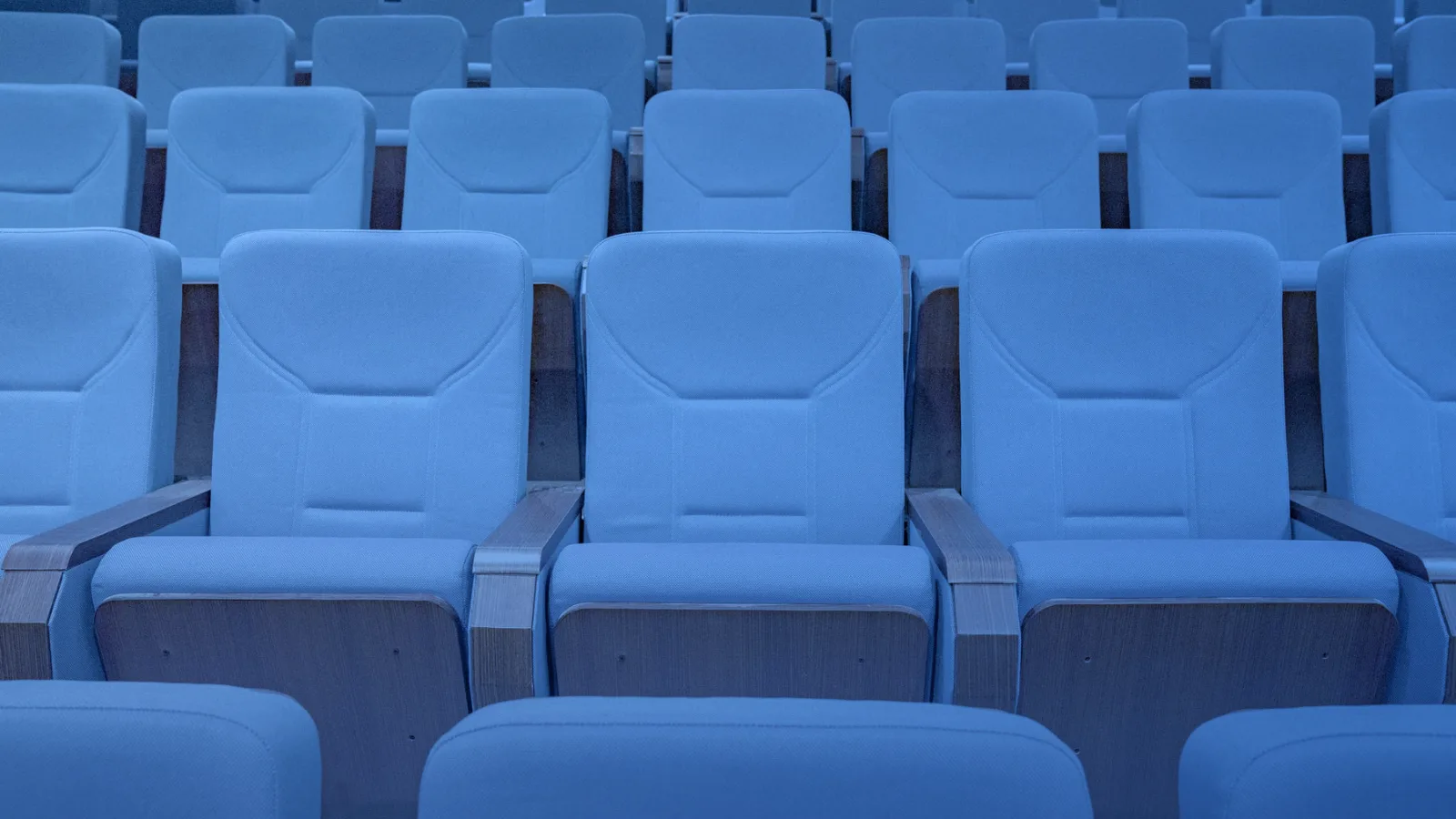
Before a graduation or a congress at full capacity, three points of the auditorium air system are checked: the low or floor grilles, the filters and drain pan of the air handlers, and the stage diffusers. The camera confirms whether what is visible at the grille continues inside the duct. The check comes before the stage setup, and the air is switched on hours before the event.
In a university protocol office the calendar rules. The graduation was set months ago, the guests confirmed, the dean reviewed the program. What almost nobody noted down is the state of the air conditioning of a hall that has not been used since the last ceremony. And the day arrives with the usual: within twenty minutes the back rows complain about the heat, in the first minutes there is a closed room smell that some link to mold, and the projector beam draws a cloud of dust nobody had noticed.
What happens to the air of an auditorium that sits almost empty for weeks?
The system sleeps, but the humidity does not. Panama records an average relative humidity of 75.7 % a year according to ETESA and IMHPA, and in a hall that is off or running at minimum that humidity comes in through the doors and the air intakes with nothing to take it out. It settles in the drain pan, in the duct lining and in the carpets. When the system starts on the day of the event, it does so cold and receives, all at once, the heat, the vapor and the carbon dioxide of a full house.
Add what the previous event left behind. Confetti, paper, carpet lint lifted by hundreds of feet, the residue of a fog machine if there was an artistic number. All of that falls to floor level, and in many auditoriums the floor is exactly where the grille is. In others the air comes in under the seat and leaves through a high grille, so floor dust travels through the plenum to the air handler.
To coordinate a visit related to university auditoriums, Climatiza answers inquiries and confirms availability according to the schedule of the place.
Why does it matter to check before the event and not after the complaints?
Because a full auditorium is unforgiving and allows no adjustments halfway through. A study that measured carbon dioxide at 82 events in seven British auditoriums (Adzic et al., 2022) found that most had good air quality, but that some showed differences between zones of the hall that revealed poor air mixing. In real life that means an auditorium can be fine on average and poor in the back rows, which is where the guests least favored by protocol end up sitting.
It also matters for the state of the equipment. An air handler with the filter loaded from the last show and a pan with old water performs worst exactly when it is asked for the most. And it matters for the peace of mind of the administration: arriving at the event with a report that says what was checked, what was done and what was left out is very different from improvising an explanation with the rector watching. The EPA recommends keeping indoor humidity below 60 % and watching pans and linings, which are the places where hidden mold shows up, and an idle auditorium has those conditions without anyone noticing.
It is also worth saying what this is not. The EPA and the CDC note that duct cleaning has not been shown to prevent health problems, so here the check is framed as comfort, odor control and a sound state of the equipment, and cleaning is only proposed if the camera shows it is needed.
What does the visit to the auditorium look like, step by step?
The visit starts in the events office with a simple question: when is the event and when does the setup begin. The check has to land before platforms, curtains and cabling go in, because afterward the floor grilles are covered. With that date clear, the technician walks the hall and opens whatever can be opened: the floor grilles, the plenum access points and the air handler room door, which is usually locked and held by maintenance, not by events.
Then the camera goes in. It passes through the low grilles, follows the plenum or the duct to the air handler and photographs each section. What shows up most are grilles blocked by paper and chewing gum, compacted dust in the first section, filters that keep the load from the last show and, sometimes, moisture in the pan. In how a camera inspection is carried out it is explained what is surveyed and what gets recorded. The camera almost always ends up ruling out work: many sections are clean and all that is needed is to change filters and switch the system on early.
An illustrative case, not a real client: a six hundred seat auditorium with floor supply and high return, unused for six weeks. The camera shows a deposit of dust and paper in the first meter of the plenum under the front rows, the rest of the run clean, and a pan with standing water. The sensible decision is to clean that section, empty and clean the pan, change the filters and leave the air on all through the day before. Cleaning the whole system would have been more work for the same result.
Which mistakes come up most before a big event?
The most common is asking for the check when the stage is already dressed, with the floor covered and the cabling laid out. Next comes switching on the air the same morning of the event, when a hall that was closed for weeks needs several hours with the system running and the doors shut to dry out and release any odor before the audience walks in. Third, assuming the events office holds the key to the air handler room, when maintenance almost always does and nobody put them on the same email.
There is a fourth, subtler mistake: treating the auditorium as a big classroom. A classroom is used daily and dries itself out. The auditorium lives on long cycles, which makes it closer to a theater with a season of shows than to the classrooms of the university, where daily routine keeps the system moving.
What is worth asking the provider for, and how is it coordinated with protocol?
- Date of the check and date of the event in the same document, with the setup marked.
- A simple plan of the seating area with the grilles that were checked marked on it.
- Photographs before and after every section worked on, with the date.
- Filters changed, with date, and the condition of each air handler pan.
- A list of what could not be opened and why, so that nobody takes it as checked.
- Recommended time to switch the air on before the event.
The protocol office does not need a long technical report. It needs a page that says the air is checked and what was left out, and maintenance needs the detail with photos. With that record the next event starts from a known point, and the decision of when cleaning is due again stops depending on someone’s memory. In the different kinds of place the service covers it is easy to see how the calendar changes with use, and the criterion is the same in all of them: look first, decide with evidence and put it in writing.
Questions about a specific building can be sent to Climatiza, and the service description shows what a visit includes.
Sources
On this site
- Theaters and auditoriumsHow the work is organized in this sector
- Universities and schoolsA neighboring sector
- Camera inspectionThe real condition before deciding
Climatiza and Radar Panamá
Why does inspecting and cleaning ducts matter?
These are the technical reasons, with their source, why the condition of the ducts is checked before deciding. Duct cleaning has not been shown to prevent health problems according to the EPA and the CDC, and it is proposed only when the observed condition justifies it.
| Advantage | Data with source | What it means in practice |
|---|---|---|
| Protect equipment performance | In a laboratory test with dust equivalent to one year of use, coil pressure drop rose between 6 and 30 % and efficiency (EER) fell between 1 and 9 % (Yang, Braun and Groll, ARTI, 2004). | It is a laboratory result and not a promise of savings: it points to the components worth checking. |
| Keep humidity under control | The EPA recommends in its guide to mold and moisture keeping indoor relative humidity below 60 % and drain pans clean and draining freely. | A humidity reading and a clean pan limit the conditions in which mold grows. |
| Require method and a report from the provider | NADCA published in 2025 the current edition of its ACR standard on assessment, cleaning and restoration of air systems. | It is an industry reference and not a seal: it helps ask for method, photographs and scope in writing. |
| Check classroom and hall ventilation | A peer reviewed study of 104 classrooms (Chan et al., 2020) found problems in 51 % of them. | The camera and readings show whether air reaches where it should before each school term. |
| A local figure that changes the decision | According to La Estrella de Panamá (July 2019), after the restoration of the Teatro Nacional, opened in 1908, its capacity stood at 753 seats and the air conditioning is switched on by area. The same report recalls that when the building was built air conditioners did not exist, and circulation depended on a more open space. (La Estrella de Panamá, the Panamanian House of Culture is reborn (July 7, 2019), in Spanish). | It is the sector context taken into account when planning the visit. |
Frequently asked questions
How long before the event is it worth checking the auditorium?
It is worth checking before the stage setup, so that the floor grilles are accessible, leaving room to change filters or clean a section if needed. The air is switched on several hours ahead or from the day before.
Does a rarely used auditorium need duct cleaning?
Not necessarily. Little use does not dirty the duct by itself, but it does favor moisture in pans and linings. The camera decides: if the sections are clean, new filters and an early start of the system are enough.
What does the camera do that a visual check of the grilles does not?
The camera shows the inside of the plenum and the duct up to the air handler. A grille that looks clean outside can have deposits further in, and a dirty grille can be only superficial. With images it is decided which section is worked on and which is not.
Which signs during an event indicate that an auditorium's ducts need inspection?
Heat in the back rows after half an hour, a stuffy smell in the first minutes, dust visible in the projector beam, and drops on the ceiling diffusers. Each sign points to a different section, and together they justify a camera inspection before the next event.
Why are the drain pans and liners of an idle auditorium monitored?
Because that is where hidden mold shows up. The EPA (2008) notes it is often found in condensate pans and porous duct liners, and recommends indoor humidity under 60 percent. With an annual mean of 75.7 percent according to ETESA, a system stopped for weeks meets the conditions for it to happen.
Keep reading the guide

Request an inspection
Do you want to know the condition of your system?
A camera inspection lets you see the inside of the ducts before deciding what to do. Message us and we will confirm availability.
- +507 6388-2083
- info@climatizapanama.com
- Calle Gervasio García, 8, Panama City