
Restaurants
Grease in restaurant ducts: how to detect it before the smell
Customers usually notice grease before the manager does. Four simple signs make it possible to notice it first.
Looking for the service for restaurants?
- The camera inspection comes first and the quote follows, with the photos in view.
- Work is done by sections and at an agreed time, so operations are not slowed down.
- At the end you receive a report with before and after photos.
 By
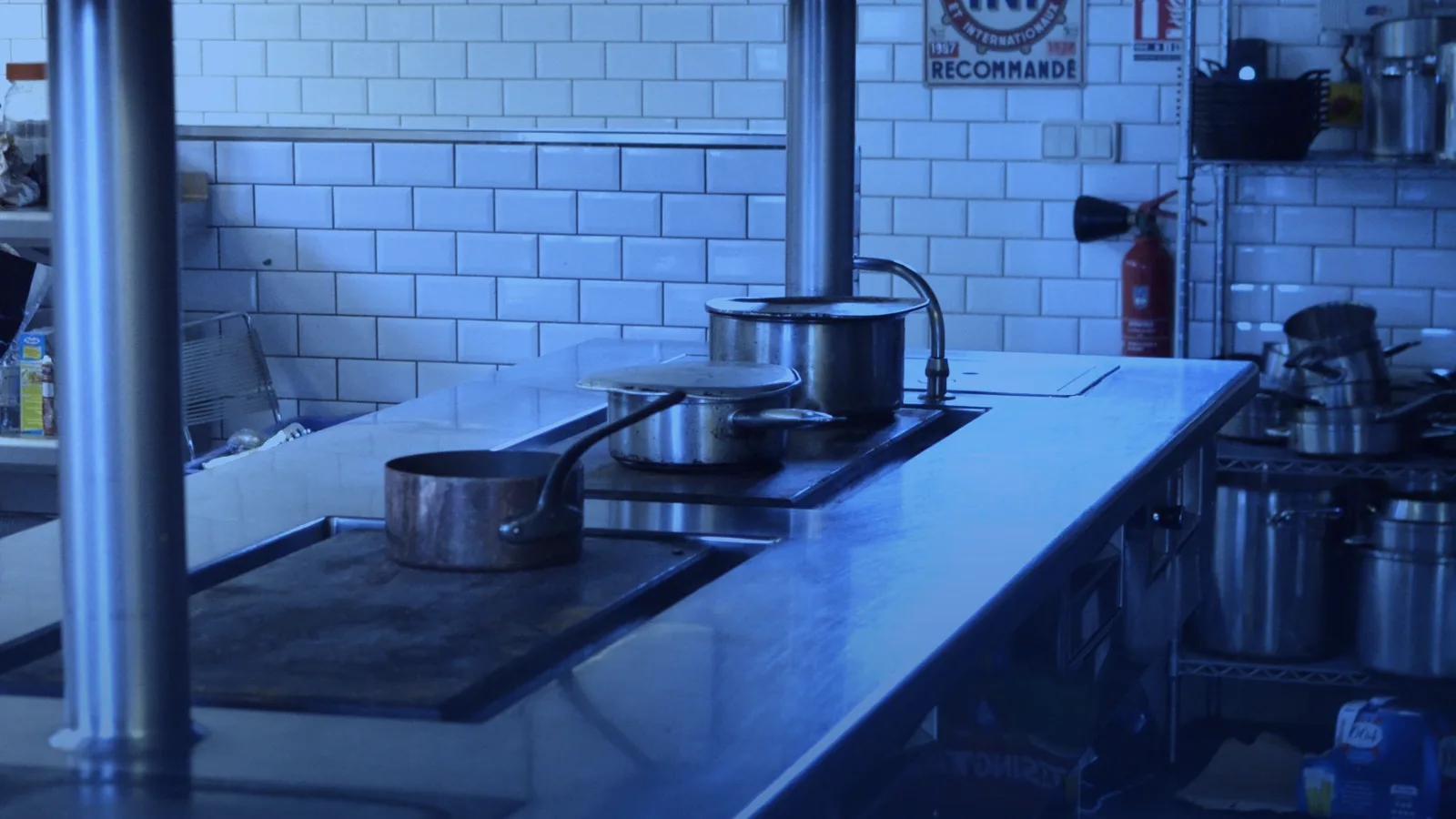
Kitchen grease has reached the dining room ducts when four signs show up: a sticky film on the return grille closest to the kitchen, filters that darken too soon, a brown halo around the diffusers and a fried smell when opening in the morning. These signs point the way, and a camera inspection confirms how much grease there is and how far it goes.
A restaurant manager often hears about the problem from a customer. A table near the kitchen smells of frying in the middle of the afternoon, another one remarks that the air “tastes of oil”, and a waiter mentions that the ceiling diffusers wake up with a dark stain. By then the grease has been traveling through the system for months.
What happens is easy to describe. The griddle and the fryer release a fine mist of oil that the hood does not fully capture. That mist floats, and if the air conditioning return grille sits near the kitchen door, it pulls the mist in, mixes it with dining room dust and spreads it through the air handler and the ducts. Over time the dust stops falling off and starts sticking.
How can anyone tell that grease has reached the dining room air?
It can be known before anything is opened, with four observations that any supervisor can make on a short walk before the doors open. The first is the return grille closest to the kitchen: if the dust does not fall off when blown and stays stuck like a film, grease aerosol is already acting as glue in that section.
The fieldwork is carried out by the Climatiza team, who check branches, grilles and air handlers and record the result in an illustrated report, also in the case of restaurants.
The second is the air conditioning filters, which darken and get heavy before their scheduled change. The third is a brown or yellowish halo around the ceiling diffusers, especially above the tables closest to the kitchen. The fourth is the smell. If the dining room smells of frying when opening in the morning, with the kitchen off since the night before, the odor comes from the duct and not from the griddle.
It helps to log each observation with a date, because the trend says more than a single photo. Even so, these signs point the way and do not confirm. Knowing how much grease there is and how far it goes takes a camera inside the duct.
Why does it matter if the restaurant keeps running?
Because grease in the air conditioning rarely causes a shutdown, but it wears down everything it touches. It holds more dust than a dry duct would, slowly clogs the coil and makes the unit work harder to cool the same room. It shows up as comfort, with tables beside the kitchen that never quite cool down, and as a lingering smell that customers read as lack of care even when the kitchen is spotless.
It also matters for order. A place with an up to date hood and an unchecked air system has a gap in its maintenance, and gaps appear at the worst moment, on a full Saturday. And it matters for the relationship with the premises administration or the building owner, who would rather have a report with photos than an argument about whose smell it is.
It is worth saying plainly what cleaning does not do. The EPA and the CDC note that duct cleaning has not been shown to prevent health problems, so here it is framed as equipment upkeep and odor control, not as protection. And it is proposed only when the camera shows it is needed.
What does a visit to a restaurant look like, step by step?
The visit starts before a single grille is opened, with a short conversation with the manager: when the kitchen closes, where the machine room is, which tables have drawn complaints. Then the technician opens the planned access points and runs the camera through three sections, which are the return that captures kitchen air, the run to the air handler and the supply toward the dining room. The first two usually hold the heaviest load, because the air still carries the warm aerosol.
What turns up most is a duct with a sheen instead of a matte look, layers of bonded dust, and droplets at the joints and on the vanes of the elbows. That is the visible difference between dry dust, which comes off when touched, and grease, which stays. The EPA guide says cleaning makes sense when there is visible build up or once the cause has been corrected, which is why the camera documents the condition before anything is decided. In how a camera inspection is carried out it is explained which sections are surveyed and what gets photographed.
An illustrative case, not a real client: an open kitchen restaurant with the return two meters from the kitchen door. The camera shows a glossy film in the first section and a clean rest of the dining room. The sensible decision is to clean that section and the coil, check the filter on that grille more often and ask the air conditioning technician to adjust the kitchen makeup air. Cleaning the whole system would have meant more work with no better result.
Which mistakes come up most often?
The first is putting the hood and the air conditioning into a single contract. The hood exhaust is a different system, covered by NFPA 96 according to the United States Fire Administration, and it is serviced by a kitchen exhaust company. If everything goes in the same package, the dining room return ends up with no one responsible.
The second is cleaning the duct without correcting the cause. If the hood does not capture well or the makeup air is badly distributed, the grease returns within weeks and the spending repeats. The balance is adjusted first and the cleaning comes after. The third is cleaning too much, the whole system when the grease lives in one section. The fourth is not keeping reference photos, because without a point of comparison nobody knows whether the residue comes back or how fast.
The split by sections and closing hours is explained in how the work is organized in a restaurant. A restaurant inside a hotel follows the same logic, except that hotel management sets the calendar and usually asks for the report by floors.
What is worth asking the provider for?
- Before and after photographs at the same points, with the date visible.
- A list of the sections surveyed and of those without access, with the reason.
- The location of the return grille that captures kitchen air.
- Condition of the filter and the coil when the air handler was opened.
- A note on the air balance for the air conditioning technician.
- A suggestion of when to look again, based on what was seen and not on a general rule.
A report like this makes it possible to compare between checks and to discuss with evidence whether to move the grille, change the filter or adjust the hood. The criteria for deciding whether cleaning is due are in when cleaning makes sense and when it does not, and the signs in this article can be entered in the inspection planner to estimate how much attention the premises need.
Those who want to go from this reading to a real review can start at the Climatiza service page or write through the main Climatiza site.
Sources
On this site
- Restaurants and coffee shopsHow the work is organized in this sector
- Hotels and hostelsA neighboring sector
- Camera inspectionThe real condition before deciding
Climatiza and Radar Panamá
Why does inspecting and cleaning ducts matter?
These are the technical reasons, with their source, why the condition of the ducts is checked before deciding. Duct cleaning has not been shown to prevent health problems according to the EPA and the CDC, and it is proposed only when the observed condition justifies it.
| Advantage | Data with source | What it means in practice |
|---|---|---|
| Follow a technical inspection reference | The ANSI/ASHRAE/ACCA 180 standard is the standard practice for inspection and maintenance of commercial HVAC systems. | It is an industry reference, not a legal requirement in Panama, and helps organize the review plan. |
| Require method and a report from the provider | NADCA published in 2025 the current edition of its ACR standard on assessment, cleaning and restoration of air systems. | It is an industry reference and not a seal: it helps ask for method, photographs and scope in writing. |
| Anticipate the tropical humidity | According to ETESA (Tocumen station, 1977 to 2010), mean annual relative humidity in Panama is 75.7 % and rises to between 78.2 and 82.4 % in the rainy months. | The condensate pan, the drain and the coil are checked first, because that is where moisture builds up. |
| A local figure that changes the decision | INEC’s Business and Establishment Directory (reference year 2022) records 13,586 establishments in the "Hotels and restaurants" category, the second largest sector by establishments after commerce (39,937), out of 96,397. The category groups lodging and food service, so it is not restaurants alone. (INEC, Business and Establishment Directory 2022). | It is the sector context taken into account when planning the visit. |
How to hire the service for restaurants
- Message us on WhatsApp with the type of place and the area.
- The camera inspection is arranged at a time that does not affect your operation.
- The quote is prepared from what was observed, never blind.
- If cleaning is justified, it is done by sections and the final report is delivered. If it is not, we tell you.
Frequently asked questions
Is grease in the dining room ducts a fire risk like in the hood?
The main fire risk sits in the hood and its exhaust duct, which is what NFPA 96 covers. In air conditioning ducts grease shows up as a thin film mixed with dust. It is not the same load, but it is worth removing because it traps more dust and holds the odor.
Can grease be detected without opening the duct?
Yes, with the four signs: dust stuck to the kitchen return, filters loading up too soon, a halo on the diffusers and a smell on opening. Knowing how much there is and how far it goes requires the camera.
Does the dining room duct need cleaning every time the hood is cleaned?
No. The hood follows its own cycle. The dining room duct is cleaned when the camera shows bonded residue, and the air balance is corrected first. Without that correction the grease comes back within weeks.
What if the kitchen return cannot be moved?
A higher efficiency filter can be fitted on that grille and checked more often. The hood can also be adjusted to capture better. The report should state which of the two options applies.
What is the difference between the kitchen hood duct and the air conditioning duct?
The hood duct pulls smoke and grease from the kitchen to the outdoors and follows NFPA 96. The air conditioning duct spreads cold air through the dining room. They are separate systems with separate cleaning. The USFA (2004) linked about 64 % of restaurant fires to cooking.
What does grease look like inside an air conditioning duct on camera?
It looks like a shiny, sticky film in amber or brown, with lint and dust stuck to it. It concentrates in the first stretch of the return nearest the kitchen and fades toward distant diffusers. The report images let each point be compared, so the need for cleaning can be judged.
Keep reading the guide
Request an inspection
Do you want to know the condition of your system?
A camera inspection lets you see the inside of the ducts before deciding what to do. Message us and we will confirm availability.
- +507 6388-2083
- info@climatizapanama.com
- Calle Gervasio García, 8, Panama City