
Operating rooms and sterile areas
Operating room: positive pressure and what to check before surgery
The positive pressure of an operating room is not achieved by a single piece of equipment. It depends on the whole path of the air, and the ducts are part of that path.
 By
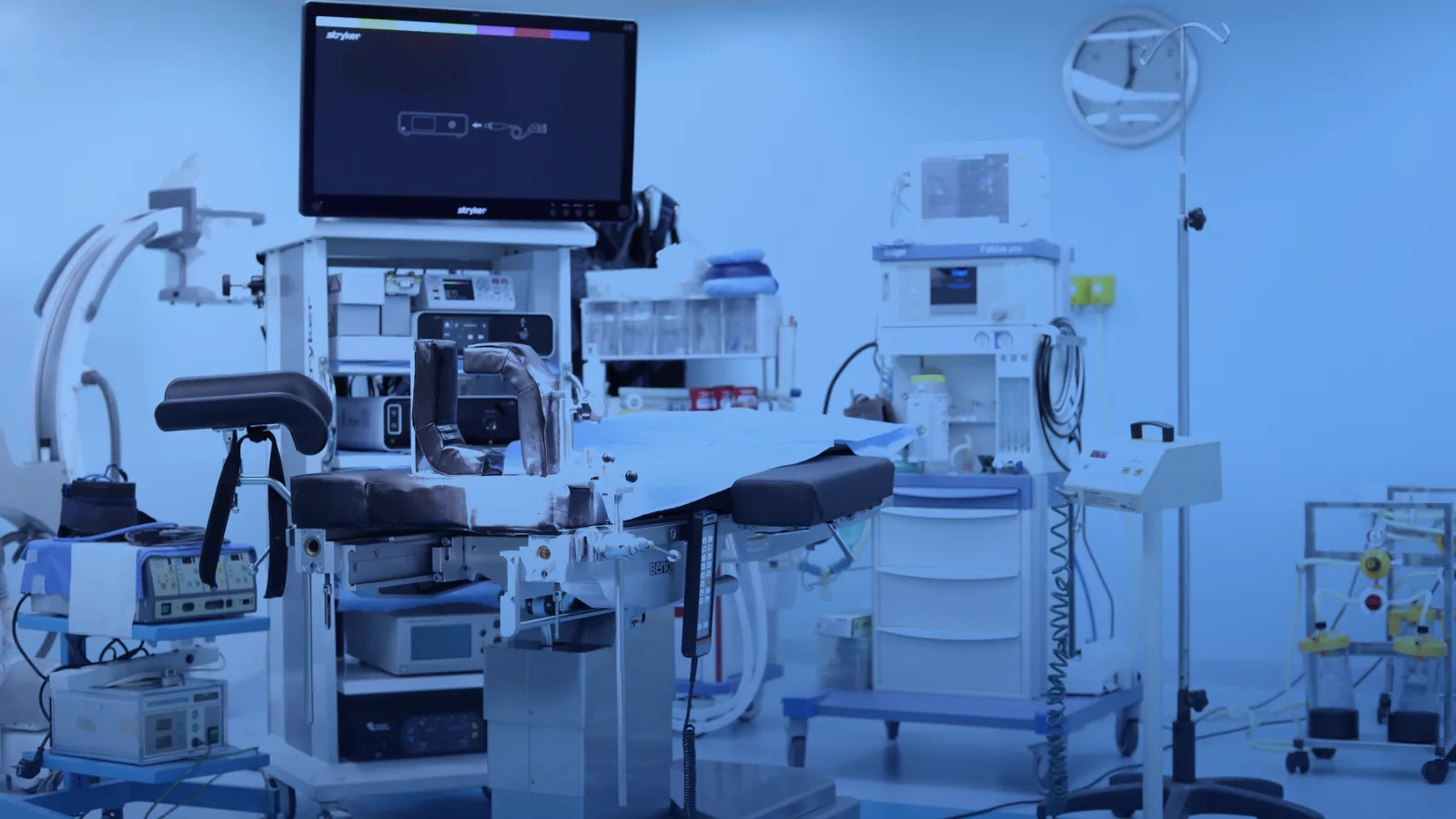
Before scheduling surgeries, the review of an operating room's ducts follows a sequence: first biomedical engineering confirms pressures and terminal filters, then the camera surveys the accessible sections upstream and downstream, and the infection committee receives the report. The camera documents the state of the duct but does not certify the room.
When an operating room goes back into use after construction, an air repair or a long stoppage, the surgeon wants a short answer: whether the room is ready. That answer never comes from a single piece of data. It comes from a reading of pressures, filters in good condition, doors that close and an air path that behaves as designed. The duct is one link in that chain and is rarely looked at.
This article explains what role the duct plays in positive pressure and in what order it is worth reviewing before scheduling surgeries. It also says plainly what a camera can do and what it cannot.
What is positive pressure and what breaks it?
Positive pressure means the air in the operating room is at a slightly higher pressure than adjacent spaces, so that when a door opens the air flows out of the room and not in. The air system achieves it by supplying more flow than it extracts, through terminal filters installed in the ceiling. It is a balance, and like any balance it breaks in several ways.
To coordinate a visit related to operating rooms and sterile areas, Climatiza answers inquiries and confirms availability according to the schedule of the place.
It is broken by doors opened too often, saturated filters that reduce flow, leaks at duct joints that lose air before it reaches the room and damper adjustments made after construction without measuring again. The duct takes part in two of those causes: if it leaks, it loses flow, and if it builds up residue or moisture, it loads the filter that follows.
Who looks after whom between the terminal filters and the duct?
The terminal filter protects the room from what comes through the duct, and a clean duct protects the filter from saturating too soon. It matters that neither is neglected. A duct that carries residue makes the filter work harder, and a broken or poorly sealed filter cancels any care the duct has received. The integrity and sealing of the filter are verified by engineering with its specific tests, not by the camera.
That fixes the scope of the visit. The camera surveys the accessible sections of the supply upstream of the terminal filter and the returns, and documents dust, moisture, damaged insulation or loose joints. It does not measure pressure, count particles or certify the room. Those tasks remain with whoever performs them.
Why does it matter to look at the duct if the room is already certified?
Because a room’s certification describes a moment, and the duct changes between one moment and another. Nearby construction, a leak in the technical ceiling or a rainy season alter what is inside. With an annual mean humidity of 75.7% according to ETESA, condensation and wet insulation are real risks in any technical space. A case study in a coastal health center, published in 2026, observed airborne fungi rising on leaving a unit and falling after a duct was replaced and surfaces cleaned, although it was a single case with more than one variable.
Honesty is needed: the CDC note that duct cleaning has not been shown to prevent health problems, and that a well designed HVAC system needs routine maintenance and monitoring. The review is framed as evidence on the state of the system, not as a promise about infections.
What review sequence is followed before surgeries resume?
- Room off the schedule. Management blocks the room and notifies biomedical engineering, the infection committee and the surgical team.
- Prior engineering reading. Engineering records differential pressures and the state of the terminal filters, and marks the duct access points.
- Camera in accessible sections. Supply and return are surveyed from the technical access panels, without entering the operative field and with a hospital escort.
- Correction and new measurement. If residue, moisture or a loose joint appears, it is corrected and engineering measures again before releasing the room.
- Report to the committee. The committee receives dated photos, the list of what was not reviewed and engineering's measurements, and decides whether to resume.
An illustrative case, not a real client: an operating room reopening after a leak in the technical ceiling is repaired. Engineering measures pressures within the expected range. The camera shows wet, darkened insulation on a stretch of the supply, upstream of the terminal filter. The committee decides to replace that stretch and measure again before reopening. Without the camera, the pressure would have come out right while the insulation stayed damp.
What should be documented for the infection committee?
A report with dated photos by section is worth handing over, along with the list of what was not reviewed and why, the corrective actions with their dates and engineering’s measurements tied to the same day. The mistakes that repeat most are cleaning without telling engineering, not measuring again after touching the duct and mixing in one report what the camera saw with what the biomedical team measured. How work is divided among restricted access areas is explained in how a review is organized in clinics and hospitals, the criteria for deciding whether a section needs cleaning are in when cleaning makes sense and when not, the camera route is detailed in how a camera inspection is carried out and the other places served are gathered in the guide to sectors.
Those who want to go from this reading to a real review can start at the Climatiza service page or write through the main Climatiza site.
Sources
- CDC: guidelines for environmental infection control in health-care facilities, air
- Pisaniello et al., 2026, J Hosp Infect: airborne fungal and particle mitigation in HVAC of a coastal healthcare facility
- Zuraimi, 2010, Indoor Air: is ventilation duct cleaning useful? A review of the scientific evidence
On this site
- Hospitals and clinicsHow the work is organized in this sector
- Industry and logistics parksA neighboring sector
- Camera inspectionThe real condition before deciding
Climatiza and Radar Panamá
Why does inspecting and cleaning ducts matter?
These are the technical reasons, with their source, why the condition of the ducts is checked before deciding. Duct cleaning has not been shown to prevent health problems according to the EPA and the CDC, and it is proposed only when the observed condition justifies it.
| Advantage | Data with source | What it means in practice |
|---|---|---|
| Protect equipment performance | In a laboratory test with dust equivalent to one year of use, coil pressure drop rose between 6 and 30 % and efficiency (EER) fell between 1 and 9 % (Yang, Braun and Groll, ARTI, 2004). | It is a laboratory result and not a promise of savings: it points to the components worth checking. |
| Keep humidity under control | The EPA recommends in its guide to mold and moisture keeping indoor relative humidity below 60 % and drain pans clean and draining freely. | A humidity reading and a clean pan limit the conditions in which mold grows. |
| Require method and a report from the provider | NADCA published in 2025 the current edition of its ACR standard on assessment, cleaning and restoration of air systems. | It is an industry reference and not a seal: it helps ask for method, photographs and scope in writing. |
| A local figure that changes the decision | INEC reports that in 2025 there were 777 health facilities in Panama, 8.0% of them hospitals. Hospital facilities had 8,575 beds, or 1.9 beds per 1,000 inhabitants. The 777 include sub-centers and health posts. (INEC, Health Services 2025). | It is the sector context taken into account when planning the visit. |
Frequently asked questions
Does a camera inspection certify an operating room?
No. The camera documents the state of the accessible duct sections. Pressure, the sealing of terminal filters and particle counts are verified by engineering with its own tests, and the decision to resume is taken by the hospital committee.
What is checked first, the filter or the duct?
First what engineering measures: pressures and the state of the terminal filters. Then the camera surveys the duct upstream, because a section with residue or moisture loads the filter. Any correction is measured again before releasing the room.
How often are an operating room's ducts reviewed?
The hospital’s protocol defines the frequency. As a practical criterion, it is worth looking after construction, leaks, long stoppages or flow changes, and when engineering detects pressure drops with no clear cause in the filters.
What does the CDC say about ventilation maintenance in a health care facility?
The CDC guidelines (2003) state that well-designed ventilation systems require routine maintenance and monitoring, and that filters are watched and changed per the manufacturer. The same guide makes clear that duct cleaning has not been shown to prevent health problems.
What is checked in the air handler serving an operating room?
The coil, condensate pan, pre-filters, dampers, fan and the condition of the terminal filter housing are reviewed. It is also verified that no standing water or buildup is present. The report with images is left available to the infection committee.
Keep reading the guide

Request an inspection
Do you want to know the condition of your system?
A camera inspection lets you see the inside of the ducts before deciding what to do. Message us and we will confirm availability.
- +507 6388-2083
- info@climatizapanama.com
- Calle Gervasio García, 8, Panama City