
Airports
Airport: boarding lounge ducts and overnight work
A boarding lounge has thousands of passengers a day and, in theory, no free hour. Checking its ducts is solved with permits in time and a well planned night.
 By
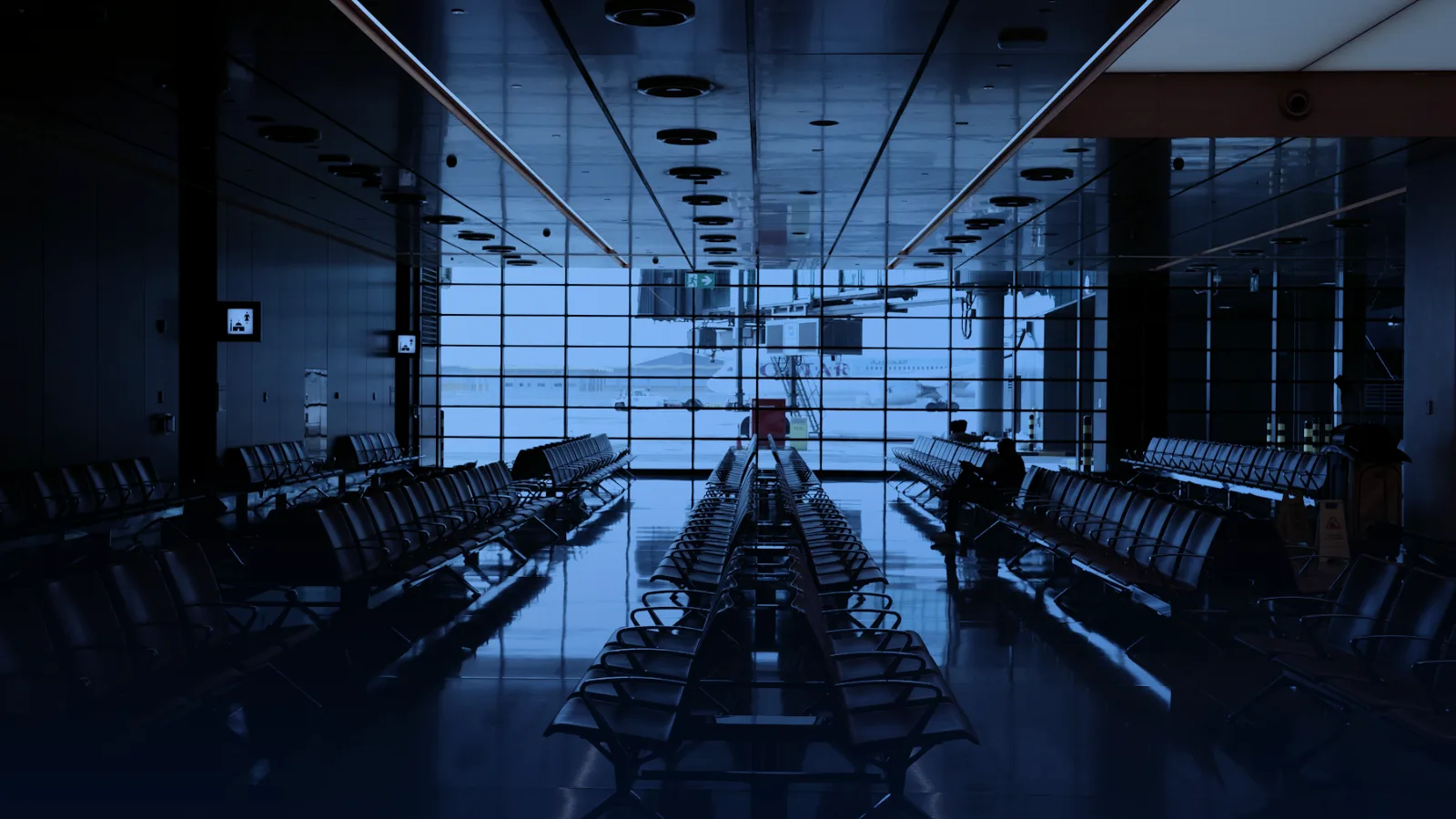
They are checked in the overnight window of lowest traffic, by lounge and by gate bridge, with accredited staff and an operator escort inside the security zone. Before the first night the permits, the equipment list and the map of which unit serves each lounge are closed. Each night one section is worked, the lounge is ready before the first flight and the operator gets a report per lounge.
A boarding lounge fills and empties several times a day. Between eleven at night and four in the morning there is a stretch where almost no flights depart, and in that stretch the air conditioning stays on because the building never shuts down. For the maintenance manager, those hours are the only real chance to look at what sits inside the ducts without anyone noticing in the morning.
The difficulty is not technical but logistical. Entering the restricted security zone, which the airport calls the sterile zone, requires permits, accreditations and an escort, and any work must be finished before the first passenger arrives at the lounge. A duct review looks more like a coordinated operation than a maintenance visit.
When and how are ducts checked if the terminal never closes?
They are checked by lounge and by gate bridge, in the overnight window of lowest traffic, with the air in the rest of the terminal running. Before the first night three things are closed: staff permits, the list of equipment going in and out, and the map of which unit serves each lounge. The exact requirements are set by the terminal operator and are requested in writing. This text does not invent rules that have not been verified.
To coordinate a visit related to airports, Climatiza answers inquiries and confirms availability according to the schedule of the place.
What changes compared with an office is the sequence. Each night one full section is worked and the lounge is left operational before the first flight. If a ceiling is opened, it is closed and cleaned the same night. If something cannot be finished, it is left sealed and marked and continued the next night, with notice to the operator.
Why does it matter in a place people just pass through?
Because passengers wait two or three hours in a lounge that is often at full capacity, and thermal comfort weighs on their experience even if they never mention it. A damp smell in the lounge, a jet of dusty air over the seats or a zone that never finishes cooling become complaints to the airline and the operator. In a terminal with hundreds of flights, those complaints have no clear owner and land on maintenance.
It also matters because of the unit’s load. A lounge that receives waves of passengers every hour forces the air handlers to work almost without rest, the filter saturates and the condensate pan receives a lot of water. A review by Seppänen and Fisk, published in Indoor Air in 2004, found that air conditioning systems can increase sick building syndrome symptoms compared with natural ventilation when they are not clean. It is an association, not a promise of the service. The EPA and the CDC note that duct cleaning has not been shown to prevent health problems, and so the section that needs it is cleaned and the rest is documented.
What does a night of work look like, step by step?
- Accreditation and escort. Staff enters with identification and accompanied by the operator, and the equipment list is verified on entering and leaving.
- Air handler and lounge return. Filter, coil and pan of the unit serving that lounge and the first section of the return are checked, which is where more dust accumulates.
- Camera in branches and bridge. The branches are run through the ceiling access panels, along with the duct feeding the boarding bridge.
- Close before the first flight. Access panels are closed, tarps and equipment removed and the lounge handed over operational with a brief note to the operator.
An illustrative case, not a real client: a terminal with eight lounges asks to review first the three that receive the most complaints. On the first night the camera shows, in one of them, the saturated filter and the pan with residue, with clean branches. The decision is to replace filters and clean the pan that same night. In another lounge, the boarding bridge duct has stuck dust and is scheduled for the next night. The remaining five lounges are left out until their own report calls for it.
Overnight work has another practical restriction: the noise and dust of opening the ceiling must be contained so as not to affect the shops and the cleaning crews working in the same window. Tarps and filtered vacuuming are used, and everything is picked up before each section is closed. That discipline is part of the scope agreed with the operator and is checked when the lounge is handed over.
Which mistakes repeat and what should the operator ask for?
The most repeated mistake is arriving without complete permits and losing the window. Next come underestimating the time to enter and exit the restricted zone, opening more ceiling than can be closed in one night and leaving a lounge without a report because “nothing happened”. When the camera shows no dirt the report is still useful: it is the starting point for the next review.
It is worth asking for a sheet per lounge with date, entry and exit times, the name of whoever escorted and an image of each section classified as clean, monitor or no action, plus the list of pending lounges with a proposed new date. How work is organized in public use spaces is summarized in the page on public buildings, and the other kinds of places the service covers show similar restricted access contexts. The camera inspection is the step prior to any cleaning, and the criteria for knowing when cleaning is due order which lounge goes first.
For a first conversation about the system, the contact details are on the Climatiza site and the method is described on its duct cleaning service page.
Sources
On this site
- Public buildings and ministriesHow the work is organized in this sector
- Hotels and hostelsA neighboring sector
- Camera inspectionThe real condition before deciding
Climatiza and Radar Panamá
Why does inspecting and cleaning ducts matter?
These are the technical reasons, with their source, why the condition of the ducts is checked before deciding. Duct cleaning has not been shown to prevent health problems according to the EPA and the CDC, and it is proposed only when the observed condition justifies it.
| Advantage | Data with source | What it means in practice |
|---|---|---|
| Require method and a report from the provider | NADCA published in 2025 the current edition of its ACR standard on assessment, cleaning and restoration of air systems. | It is an industry reference and not a seal: it helps ask for method, photographs and scope in writing. |
| Know whether cleaning is needed before deciding | The EPA states in its duct cleaning guide that cleaning is justified for visible mold, pests or a notable buildup of dust and debris. | A camera inspection documents the condition and allows a decision based on evidence, without unnecessary work. |
| Protect equipment performance | In a laboratory test with dust equivalent to one year of use, coil pressure drop rose between 6 and 30 % and efficiency (EER) fell between 1 and 9 % (Yang, Braun and Groll, ARTI, 2004). | It is a laboratory result and not a promise of savings: it points to the components worth checking. |
| A local figure that changes the decision | In August 2026 Panama’s public sector had 270,301 employees, and 175,532 of them belonged to the central government. (Comptroller General of the Republic, Public sector payroll report, August 2026). | It is the sector context taken into account when planning the visit. |
Frequently asked questions
Is a boarding lounge closed to check its ducts?
Work is done in the overnight window of lowest traffic and the lounge is handed over operational before the first flight. If the section is not finished in one night, it is left sealed and marked and continued the next, with notice to the operator.
Who sets the requirements for entering the security zone?
The terminal operator. They are requested in writing before scheduling and the file is prepared with technicians’ names, equipment list and scope. This article does not replace that document nor cite requirements that have not been verified.
How often are the ducts of a boarding lounge checked?
No standard was found that sets the frequency. The ASHRAE 180 standard serves as a reference for documenting tasks and frequencies per component, and the camera is used on complaints about odor, airflow or dust on diffusers.
What happens if a delayed flight occupies the gate right when the inspection was planned?
The section under way is closed and cleared, and the gate goes back to the operator with nothing left half done. The operator indicates which other sector is free that night, or the work is rescheduled. That is why the plan is built from small sections that can be finished and removed with all access panels closed.
Why does the air in a boarding lounge feel heavy when the flight is full?
Because hundreds of people gather in a small space and the bridge door lets hot, humid outside air in at every boarding. The EPA’s Building Air Quality guide lists occupancy among the factors behind complaints of stuffy air. The camera reveals whether returns and filters contribute.
Keep reading the guide

Request an inspection
Do you want to know the condition of your system?
A camera inspection lets you see the inside of the ducts before deciding what to do. Message us and we will confirm availability.
- +507 6388-2083
- info@climatizapanama.com
- Calle Gervasio García, 8, Panama City