
Clinical laboratories
Clinical laboratory: ducts above the sample area and analyzers
In a laboratory the air matters in two very different places: where the patient arrives and where the equipment works.
 By
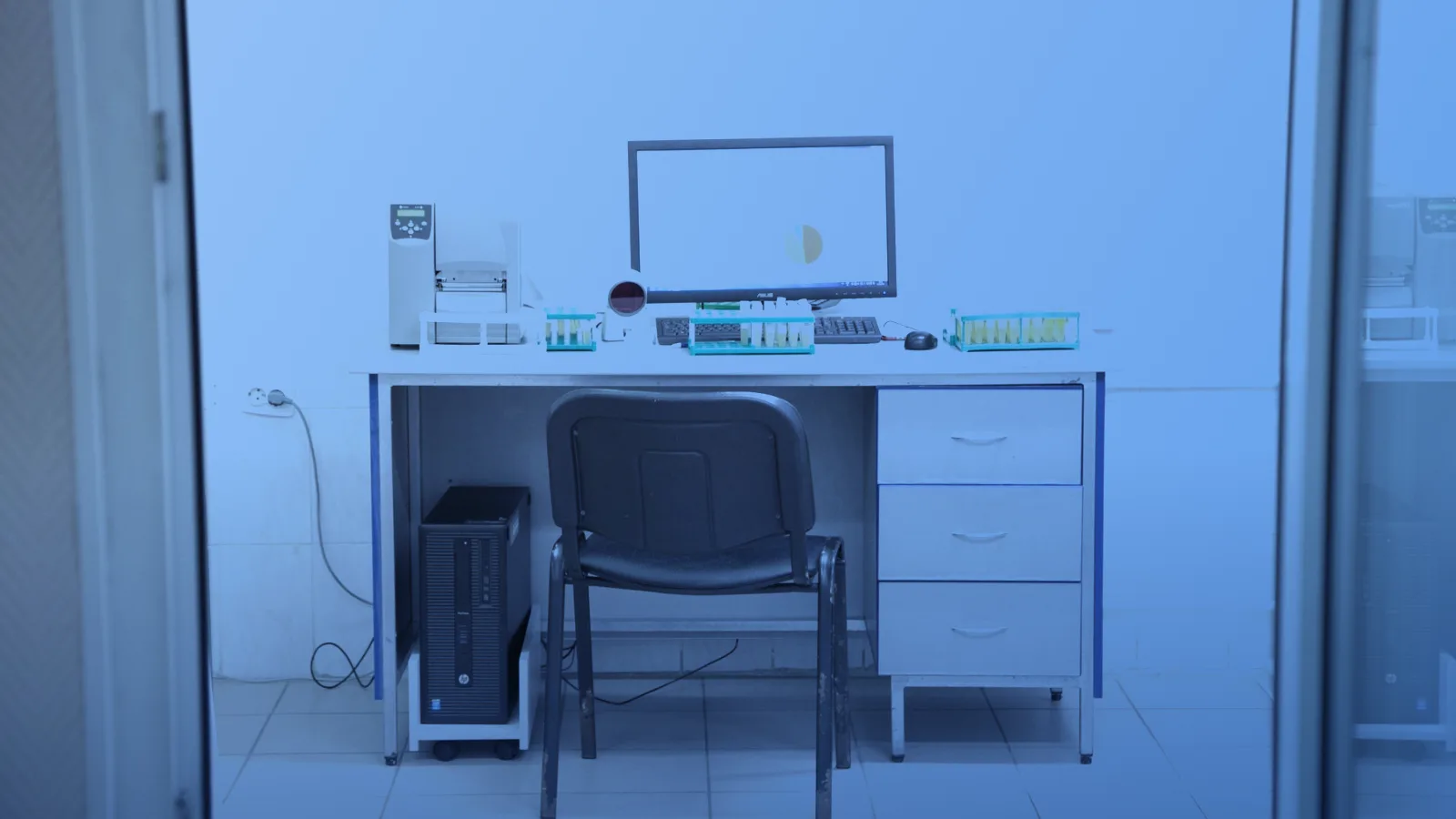
In a clinical laboratory the ducts above the analyzers and above the sample preparation bench are checked first, because there dust or dripping affects daily work. The collection area comes after. The camera enters through the grilles without moving equipment, the visit is agreed with the lab head and the report keeps each area apart.
The head of a clinical laboratory knows the day an analyzer starts asking for maintenance more often, or the processing bench wakes up with a thin layer of dust that cleaning does not explain. Nobody thinks at once of the air conditioning, because the diffuser is in the ceiling and the equipment sits on the bench. But the air leaving the diffuser is the same air that bathes the work table, and if the duct loads it with dust, that dust ends up where the laboratory wants it least.
This article explains what is worth looking at in those ducts, in what order and what the review yields. It starts from a simple idea: not the whole laboratory calls for the same attention, and spreading it well is what makes the visit useful.
Why are sample collection and processing two different loads?
Because one has people coming in and the other has equipment at work. Sample collection receives patients all day, with the door open, air from the street or the waiting room and a flow of people like that of a doctor’s office. Processing is a closed space, with few occupants, a lot of equipment that gives off heat and a temperature that must stay steady so the analyzers work within their range.
Climatiza is the technical service behind this guide and works with camera inspection, an illustrated report and cleaning only when the condition justifies it, including in the case of clinical laboratories.
In the first area comfort and entrance dust weigh most. In the second, stability and whatever falls on the equipment weigh most. That difference orders the visit: processing goes first, because it is where a duct with dust or condensation has the most direct consequences, and the collection room is checked afterward with the criteria of any customer-facing premises.
What about the dust that falls on analyzers and samples?
Many analyzers draw in room air to cool their components and have a filter of their own that collects what the environment brings. If the duct above the equipment sheds dust, that filter loads up sooner and the equipment’s maintenance comes earlier. Over the bench, the dust that falls builds up on surfaces the staff clean daily, and that cleaning does not settle where it comes from.
Care is needed with what gets blamed on the air. If a piece of equipment gives odd readings, the first thing checked is the equipment itself, its calibration and its reagents, and the duct joins the list only when there is a concrete reason, such as visible residue on the nearest diffuser or a grille that drips. The camera serves exactly for that: ruling out with an image instead of assuming, or finding the residue that explains the dust nobody understood.
Why does it matter if the laboratory keeps running?
It matters for the continuity of work. A laboratory lives on delivering results on time, and equipment that stops for early maintenance or because of a leak over the bench breaks that promise. It matters for temperature, because an air handler that condenses too much or distributes badly upsets the room where the analyzers work. With an annual mean humidity of 75.7% according to ETESA, condensation is the first suspect when something drips.
It also matters for record keeping. A laboratory with internal or accreditation audits needs to show that it looks after its environmental conditions, and a report with dated images of the state of the ducts is one more piece of that file. Even so it is fair to say plainly that, according to the EPA and the CDC, duct cleaning has not been shown to prevent health problems. The review is proposed for the condition of the system, never as a sanitary measure.
What does the visit look like without touching samples or stopping equipment?
The day and hour are agreed with the head of the lab, when the equipment is not running long batches and no open samples are on the bench. Staff cover the analyzers and any material that cannot be moved, a lab employee escorts the technician and nobody photographs screens, labels or samples. The camera goes in through the existing grilles and access panels, without moving equipment and without opening the ceiling above the bench unless needed.
- Processing first. Diffusers and returns above analyzers, the supply branch of the room and the air handler that serves it.
- Rooms with sensitive temperature. The duct of the rooms where reagents and delicate equipment are kept is looked at.
- Collection area and waiting room. Grilles of the room and corridor, with the criteria of customer-facing premises.
- Report by area. Dated photos by zone and a list of what was not seen because of protocol.
An illustrative case, not a real client: a laboratory with two analyzers under the same diffuser. The equipment technician noticed that the internal filters loaded up early. The camera shows caked dust in the branch feeding that diffuser and a return grille partly blocked. The sensible decision is to clean that branch, uncover the return and note the date and condition in the maintenance log, without touching the rest of the system.
Which mistakes repeat and what is worth asking for?
The first is cleaning the duct without covering or protecting the equipment, because the dust that comes loose falls exactly where it should not. The second is cleaning the whole network when the problem was in one branch, and the third is recording nothing, so nobody knows whether the dust comes back. It is also common to treat the collection area with the criteria of processing, and the other way round.
It is worth asking for a report by area with dated photos, the list of what was not reviewed and why, a note on blocked grilles or returns and a suggestion of when to look again, tied to works, equipment changes or complaints and not to a rigid calendar. The split by areas with restricted access is explained in how a review is organized in clinics and hospitals. To decide whether a section needs cleaning there are the criteria for deciding whether cleaning is due, the camera route is in how a camera inspection is carried out and the other places served are gathered in the guide to sectors.
Questions about a specific building can be sent to Climatiza, and the service description shows what a visit includes.
Sources
On this site
- Hospitals and clinicsHow the work is organized in this sector
- Pharmacies and laboratoriesA neighboring sector
- Camera inspectionThe real condition before deciding
Climatiza and Radar Panamá
Why does inspecting and cleaning ducts matter?
These are the technical reasons, with their source, why the condition of the ducts is checked before deciding. Duct cleaning has not been shown to prevent health problems according to the EPA and the CDC, and it is proposed only when the observed condition justifies it.
| Advantage | Data with source | What it means in practice |
|---|---|---|
| Anticipate the tropical humidity | According to ETESA (Tocumen station, 1977 to 2010), mean annual relative humidity in Panama is 75.7 % and rises to between 78.2 and 82.4 % in the rainy months. | The condensate pan, the drain and the coil are checked first, because that is where moisture builds up. |
| Protect equipment performance | In a laboratory test with dust equivalent to one year of use, coil pressure drop rose between 6 and 30 % and efficiency (EER) fell between 1 and 9 % (Yang, Braun and Groll, ARTI, 2004). | It is a laboratory result and not a promise of savings: it points to the components worth checking. |
| Follow a technical inspection reference | The ANSI/ASHRAE/ACCA 180 standard is the standard practice for inspection and maintenance of commercial HVAC systems. | It is an industry reference, not a legal requirement in Panama, and helps organize the review plan. |
| A local figure that changes the decision | INEC reports that in 2025 there were 777 health facilities in Panama, 8.0% of them hospitals. Hospital facilities had 8,575 beds, or 1.9 beds per 1,000 inhabitants. The 777 include sub-centers and health posts. (INEC, Health Services 2025). | It is the sector context taken into account when planning the visit. |
Frequently asked questions
Can dust from a duct alter an analyzer's results?
It should not be assumed. The first thing checked when readings look odd is the equipment, its calibration and its reagents. The duct is looked at when there is a concrete reason, such as residue on the nearby diffuser, and the camera lets it be confirmed or ruled out with an image.
Do the analyzers have to be stopped for the visit?
Not necessarily. An hour without long batches or open samples is chosen, the equipment is covered and the camera goes in through the existing grilles. If the ceiling above a piece of equipment must be opened, that is agreed beforehand with the lab head.
Which area of the laboratory is checked first?
The processing area, above analyzers and bench, because there dust or dripping affects daily work. The sample collection room and the waiting room come afterward, with the criteria of any premises open to the public.
What temperature and humidity do clinical lab analyzers need?
Each manufacturer sets the range in the equipment manual, and that document prevails over any general figure. The lab logs room temperature and humidity and compares them with that range. If deviations appear, airflow, filter and the duct feeding the room are checked.
What is done if a drop of condensate falls near an analyzer?
The equipment is protected, the lab manager is notified and the analyzer is not moved on anyone’s own initiative. Then the diffuser, duct insulation and air handler pan are checked to find the source. The finding is logged in the maintenance book with date and photo.
Keep reading the guide

Request an inspection
Do you want to know the condition of your system?
A camera inspection lets you see the inside of the ducts before deciding what to do. Message us and we will confirm availability.
- +507 6388-2083
- info@climatizapanama.com
- Calle Gervasio García, 8, Panama City