
Supermarkets
Supermarket: ducts above produce, meat and in-store bakery
A supermarket does not have a single kind of air. It has a dry aisle, a butcher counter, an oven and open refrigeration under the same roof.
 By
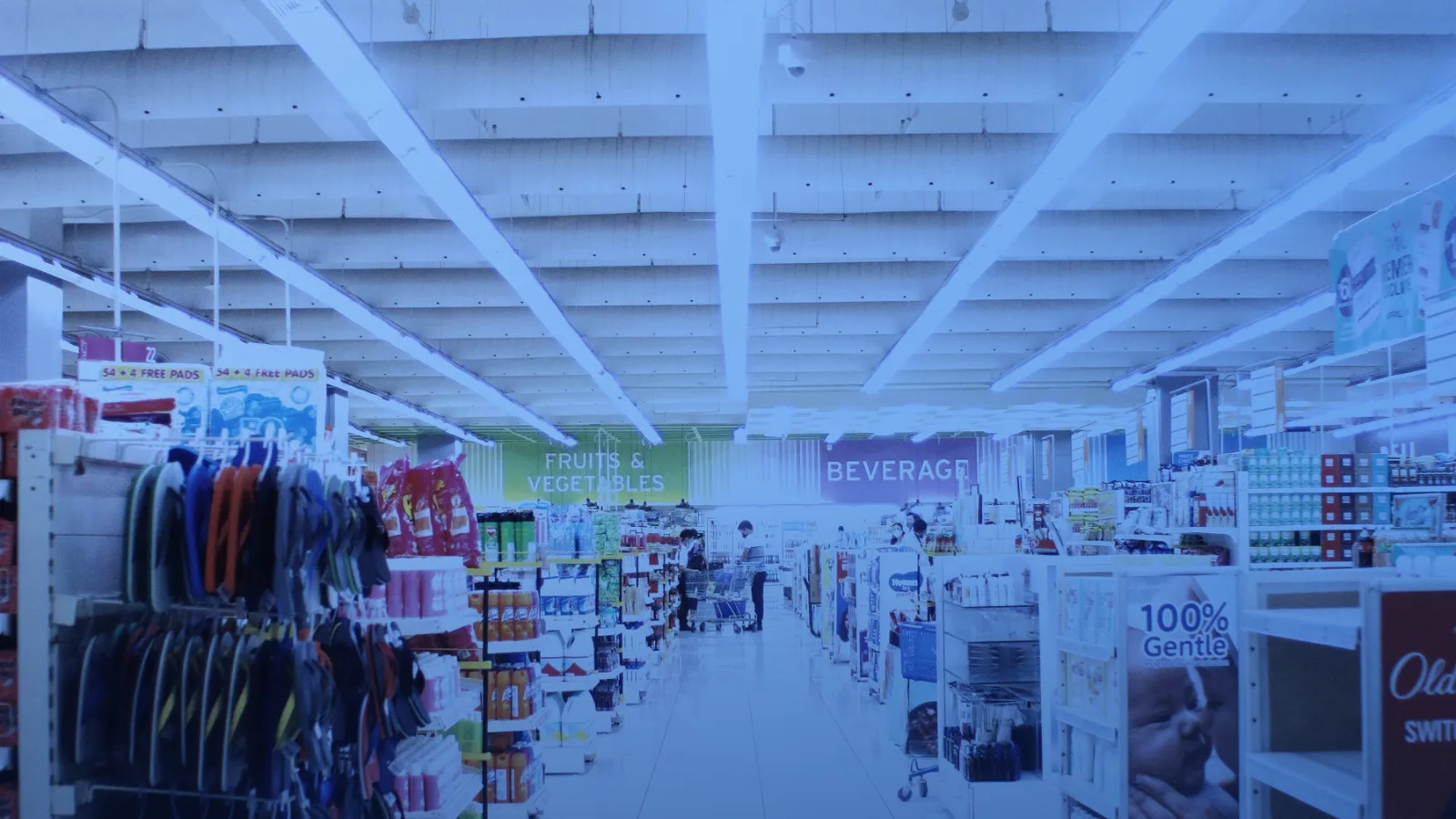
In a supermarket the ducts work hardest above the bakery and rotisserie (steam and grease), above meat and fish (moisture and cold) and above open refrigerated produce, and least above dry aisles. A load map makes it possible to schedule the camera inspection by zone, at night and without closing the store, and to ask for a report per zone.
The manager of a supermarket walks the store first thing and knows its weak points without looking at any report. The bakery corner, where the air smells of warm bread until midday. The butcher counter, where the ceiling grille always has a drop. The dairy aisle, which is colder than it should be. The dry aisles, by contrast, cause no trouble.
That map of hunches is the right starting point. The air system of a large store is spread over very different zones, and treating it as a single block, whether to clean everything or to touch nothing, wastes effort. What helps is knowing where the duct works hardest and checking there first.
Where do the ducts of a supermarket work hardest?
There are three high load zones. The first is the in-store bakery and rotisserie, which release steam, oil and flour particles into the air going to the return. The second is the meat, fish and dairy zone, where the cold of the display cases and the moisture of handling create condensation. The third is open refrigerated produce, whose cold air curtains collide with the warm air of the store.
Climatiza is the technical service behind this guide and works with camera inspection, an illustrated report and cleaning only when the condition justifies it, including in the case of supermarkets.
The dry aisles, the checkouts and the entrance have a normal dust load and follow the general calendar. Research on supermarkets treats the open display case and the air conditioning as a single system, because the cold air that escapes from one affects the load of the other (Wu and colleagues, 2015, International Journal of Heat and Mass Transfer). That explains why a grille near open refrigeration can drip even when the duct is clean.
Why does the order of zones matter and what is gained from it?
It matters because it orders the work. A 2,000 square meter store can have dozens of grilles, and only some are above zones that count. With a load map it is decided which are inspected with the camera, which are cleaned at the grille and which are left to the general calendar. The result is a short report, useful for management, and not a dump of photographs of every duct.
It also matters for the product. The FDA Food Code, in section 6-202.12, asks that the intakes and outlets of the climate system not contaminate food or contact surfaces, and 6-501.14 says that intake and exhaust ducts are cleaned and filters changed so they are not a source of contamination. It is a United States reference, not a Panamanian standard, but it describes a sensible logic: looking at the grilles above exposed product more carefully than the others.
On health, the EPA and the CDC state that duct cleaning has not been shown to prevent health problems, and it is not framed that way here. It is framed as store upkeep: avoiding drips onto product, controlling odors and keeping the equipment in good condition.
How is it scheduled by zone without closing the store?
- Night 1: bakery and rotisserie. With the ovens off and the bread cases empty. It is the zone with the most grease and steam, and the one that benefits most from being seen first.
- Night 2: meat, fish and produce. Product covered or moved to cold storage, display cases in normal mode to see the real condensation on the cold sections.
- Night 3: checkouts, entrance and dry aisles. A quicker review, with the camera only where the grille shows load, and the filters of the general units.
An illustrative case, not a real client: a mid-sized supermarket with its own bakery. The load map marks the bakery as a high zone and the aisles as a low zone. The camera shows an oily film in the return above the bakery and the aisle sections almost clean. The sensible decision is to clean that return and its coil, change the filters of that unit more often and leave the aisles on the general calendar. The criteria for a bakery with its own production apply here as they are.
Which mistakes recur and which report to ask for?
The most common mistakes are cleaning the whole network as if it were one zone, scheduling during the day with exposed product and treating a drip over display cases as solved by cleaning the duct when the cause is the clash between the refrigeration air curtain and the diffuser. Another is saving photos without a zone, so nobody knows which part of the store each image belongs to.
- One report per zone, with dated photos and a recommendation: clean, monitor or no action.
- A map of the store with the grilles numbered and their load high, medium or low.
- A record of how the product was protected during the work.
- Condition of the condensate pan and the drain of the main units.
- A list of the sections that could not be reviewed and the reason.
The general criterion for deciding what follows the inspection is in the criteria for when to clean, and the method is described in the camera inspection. How the work is organized in a store with a sales floor provides the broader frame, and the other types of premises show the variants.
Those who want to go from this reading to a real review can start at the Climatiza service page or write through the main Climatiza site.
Sources
On this site
- Stores and supermarketsHow the work is organized in this sector
- Bakeries and pastry shopsA neighboring sector
- Camera inspectionThe real condition before deciding
Climatiza and Radar Panamá
Why does inspecting and cleaning ducts matter?
These are the technical reasons, with their source, why the condition of the ducts is checked before deciding. Duct cleaning has not been shown to prevent health problems according to the EPA and the CDC, and it is proposed only when the observed condition justifies it.
| Advantage | Data with source | What it means in practice |
|---|---|---|
| Anticipate the tropical humidity | According to ETESA (Tocumen station, 1977 to 2010), mean annual relative humidity in Panama is 75.7 % and rises to between 78.2 and 82.4 % in the rainy months. | The condensate pan, the drain and the coil are checked first, because that is where moisture builds up. |
| Protect equipment performance | In a laboratory test with dust equivalent to one year of use, coil pressure drop rose between 6 and 30 % and efficiency (EER) fell between 1 and 9 % (Yang, Braun and Groll, ARTI, 2004). | It is a laboratory result and not a promise of savings: it points to the components worth checking. |
| Follow a technical inspection reference | The ANSI/ASHRAE/ACCA 180 standard is the standard practice for inspection and maintenance of commercial HVAC systems. | It is an industry reference, not a legal requirement in Panama, and helps organize the review plan. |
| A local figure that changes the decision | INEC’s Business and Establishment Directory (reference year 2022) records 39,937 wholesale and retail trade establishments, including Free Zones, and vehicle repair, the sector with the most establishments in the country, out of 96,397. The category is broad and does not separate supermarkets or stores. (INEC, Business and Establishment Directory 2022). | It is the sector context taken into account when planning the visit. |
Frequently asked questions
Does the supermarket have to close for the ducts to be inspected?
Not necessarily. It is scheduled by zone at night, with the product covered or removed in the work area and the rest of the store unchanged. The camera dismantles nothing and the work is targeted.
Why does a grille next to open refrigeration drip?
Because the cold air escaping from the case cools the diffuser metal below the dew point of the store air. The cause is usually airflow direction or humidity, not duct dust, and it is corrected by moving or reorienting.
Are all the grilles treated the same?
No. Those above exposed product, bakery and rotisserie are checked first and in more detail. Those over dry aisles and checkouts follow the general calendar. That difference avoids unnecessary work and organizes the report.
Why does water condense on the duct that runs over open refrigerated cases?
Open cases spill cold, humid air, and if the duct insulation is insufficient or damaged, the surface drops below its dew point and drops form. The camera looks at the covering and seams of that stretch, and the report says whether repairing the insulation is enough.
What should a supermarket duct map include?
It should include a plan marking the bakery, deli, fresh produce and storeroom zones, numbered grilles, the unit feeding each one and the inspection priority. With that map management knows what was checked and on what date, and the next shift resumes without repeating zones.
Keep reading the guide

Request an inspection
Do you want to know the condition of your system?
A camera inspection lets you see the inside of the ducts before deciding what to do. Message us and we will confirm availability.
- +507 6388-2083
- info@climatizapanama.com
- Calle Gervasio García, 8, Panama City