
Coffee shops
Coffee shop with roasting or bar: what smoke does to the ducts
The smell of freshly ground coffee is a coffee shop’s best advertisement. When the shop’s air starts to smell of old coffee, the problem is usually above the ceiling.
 By
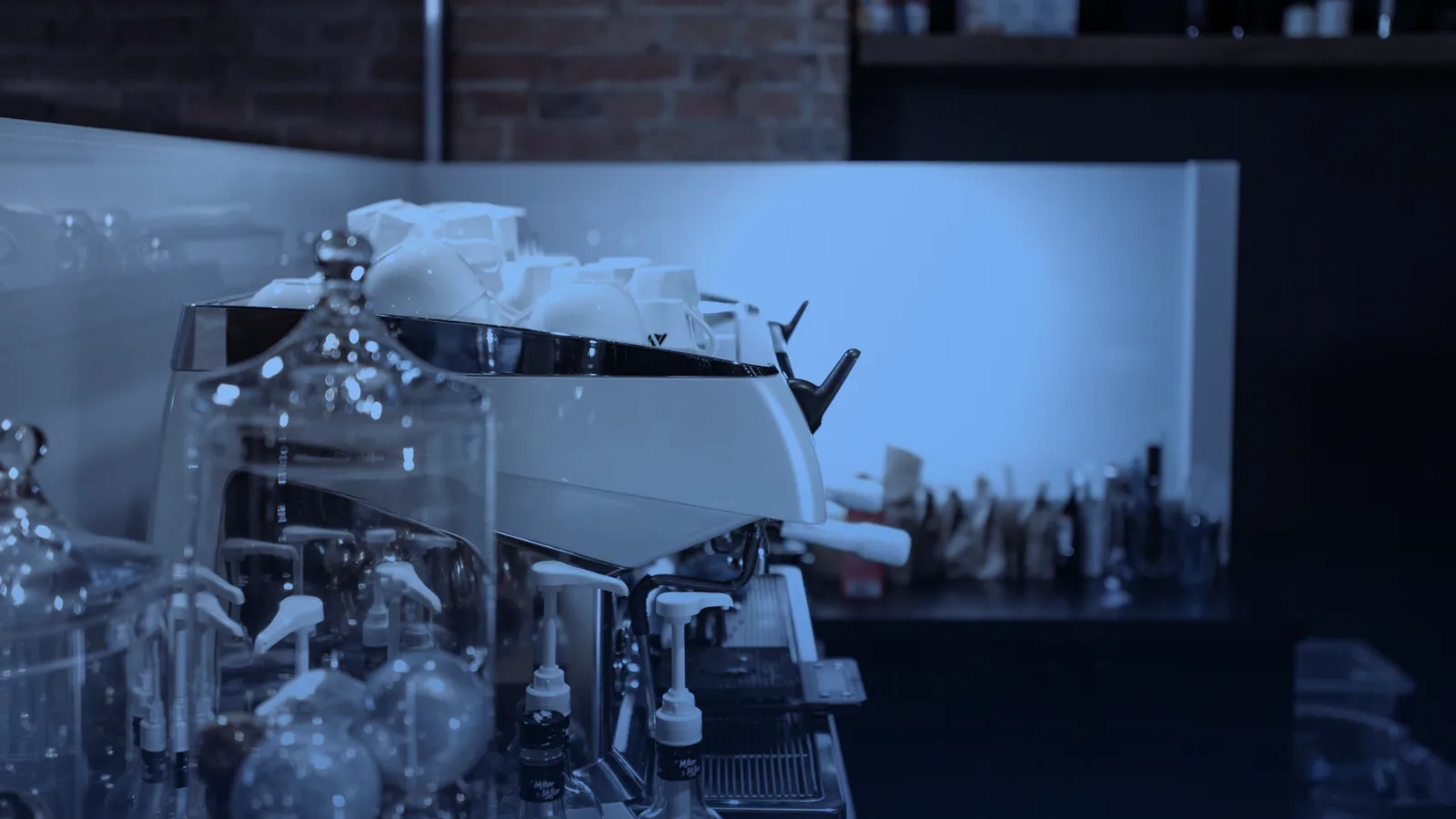
Yes, roasting smoke stays in the ducts. It contains fine particles, volatile organic compounds and organic acids, according to the EPA, and that mixture sticks to the duct walls and grilles. The espresso machine’s steam supplies the moisture that fixes it. The result shows in a flat aroma and in grilles that darken.
A coffee shop with its own roaster has a luxury problem: it smells so good that nobody thinks about what happens to the air the rest of the day. But after a few months the regulars start to remark that the coffee “no longer smells like before”. Customers who walk in from the street notice a roasted, stale smell. The slats of the grille above the bar, which were gray, are brown.
Behind that scene there is a simple physical explanation. Roasting produces smoke and the bar produces steam, and both end up in the same place if the air conditioning return is nearby. Understanding what each contains helps decide what to check and what to correct before thinking about cleaning anything.
Does roasting smoke really stay in the ducts?
Yes, and the reason lies in its composition. The EPA AP-42 document on coffee roasting describes emissions of particulate matter, volatile organic compounds, organic acids and burner combustion products. A 2026 field study in small roasteries collected the smoke condensate and found it acidic and loaded with organic compounds. Those particles are not dry dust: they come with oils from the bean and with the compounds that give the aroma, and on cooling inside the duct they condense into a slightly sticky brown film that traps ordinary dust.
To coordinate a visit related to coffee shops, Climatiza answers inquiries and confirms availability according to the schedule of the place.
At the scale of a coffee shop the quantities are modest, but the film does not need much. A roaster that runs a few hours a week is enough for the first section of the return to show it within a few months, especially if the roaster sits under a diffuser or near a return grille.
What does the espresso machine’s steam add?
It adds the moisture that turns a film into a layer that is hard to remove. The machine releases steam every time the group is purged or milk is steamed, and on a busy bar that means hundreds of purges a day, almost always under a return grille placed right above. Since Panama’s annual mean humidity is 75.7% according to ETESA, the air reaching the coil already comes near saturation, and the bar steam pushes it a bit further.
Dry smoke can be vacuumed. Damp smoke, mixed with dust and traces of milk in aerosol, forms a layer that only comes off with mechanical cleaning. That is why the grille above the bar is the first point looked at, and why simply wiping the slats with a cloth does not solve the source.
Why does it matter if the coffee shop stays open?
It matters because in a coffee shop the aroma is part of the product. A place that smells of old coffee loses exactly what sets it apart from the competition, and the owner usually finds out from a review and not from an inspection. It matters for comfort, because a loaded grille distributes air poorly and the tables at the back warm up. And it matters for the equipment, which works harder if the coil receives film instead of clean air.
It is worth being clear about what is not promised. The EPA and the CDC note that cleaning ducts has not been shown to prevent health problems, and in a coffee shop nobody should hire it for that. It is done for the aroma, for the condition of the equipment and for order, and it is done only when the camera shows bonded residue. Before that, the EPA guide asks to correct the cause, which here is usually a roaster without its own extraction or a badly placed return grille, and the air conditioning technician solves that.
How does it show in the shop and how is it inspected without closing?
The signs are concrete. The aroma of freshly ground coffee is noticed at the bar and not at the tables at the back. When opening in the morning the shop smells of old coffee. The slats above the bar went from gray to brown. The ceiling around the diffusers shows a dark halo. Two of these signs together justify looking inside the duct, and the camera inspection is done at the quietest hour of the shop, which in many coffee shops is early afternoon.
- Quiet hour. The roaster is scheduled for another day and the bar keeps serving while the work is done.
- Grille above the bar. It is removed, photographed and the camera goes in through the return. It is the section with the most residue and decides whether to continue.
- Section above the roaster. If the roaster sits under a diffuser, that diffuser receives smoke each time the air is off and the smoke rises, so it is checked even if far from the bar.
- Unit and filter last. Opening the unit turns the air off for a few minutes, so it is done when fewer tables are occupied.
An illustrative case, not a real client: a coffee shop with a five kilo roaster and a single unit. The camera shows a brown film in the first section of the return above the bar and the rest of the duct unremarkable. The sensible decision is to clean that section and the coil after closing, move the roaster away from the diffuser and check the grille with a monthly photo. Cleaning the whole system would have added nothing.
Which mistakes repeat and what is worth asking for?
The most frequent mistake is fighting the symptom with air fresheners on the grille, which add one more aroma to the mix and also deposit in the duct. Next come cleaning the slats without looking inside, roasting without its own extraction and not keeping a reference photo. A simple monthly routine avoids finding out about the problem through a review: a photo of the grille above the bar on the same day each month, a filter check to see whether the residue is loose dust or an oily layer and a log of roasting hours.
From the provider it is worth asking for images of the return above the bar and of the section above the roaster, a note separating smoke residue from ordinary dust and a suggestion of when to look again according to use. How the work is done in a small shop is explained in restaurants and cafeterias, the whole picture in the sectors served and the criteria for deciding in when to clean and when to wait. When there is flour as well as coffee, the case of a bakery with a café adds other signs.
Those who want to go from this reading to a real review can start at the Climatiza service page or write through the main Climatiza site.
Sources
On this site
- Restaurants and coffee shopsHow the work is organized in this sector
- Bakeries and pastry shopsA neighboring sector
- Camera inspectionThe real condition before deciding
Climatiza and Radar Panamá
Why does inspecting and cleaning ducts matter?
These are the technical reasons, with their source, why the condition of the ducts is checked before deciding. Duct cleaning has not been shown to prevent health problems according to the EPA and the CDC, and it is proposed only when the observed condition justifies it.
| Advantage | Data with source | What it means in practice |
|---|---|---|
| Require method and a report from the provider | NADCA published in 2025 the current edition of its ACR standard on assessment, cleaning and restoration of air systems. | It is an industry reference and not a seal: it helps ask for method, photographs and scope in writing. |
| Know whether cleaning is needed before deciding | The EPA states in its duct cleaning guide that cleaning is justified for visible mold, pests or a notable buildup of dust and debris. | A camera inspection documents the condition and allows a decision based on evidence, without unnecessary work. |
| Protect equipment performance | In a laboratory test with dust equivalent to one year of use, coil pressure drop rose between 6 and 30 % and efficiency (EER) fell between 1 and 9 % (Yang, Braun and Groll, ARTI, 2004). | It is a laboratory result and not a promise of savings: it points to the components worth checking. |
| A local figure that changes the decision | INEC’s Business and Establishment Directory (reference year 2022) records 13,586 establishments in the "Hotels and restaurants" category, the second largest sector by establishments after commerce (39,937), out of 96,397. The category groups lodging and food service, so it is not restaurants alone. (INEC, Business and Establishment Directory 2022). | It is the sector context taken into account when planning the visit. |
Frequently asked questions
Does roasting smoke damage a coffee shop’s air conditioning?
Over time it leaves a film in the return and in the first section, which traps dust and can reach the coil. That reduces airflow and dulls the shop’s aroma. It is confirmed with the camera and the cause is corrected first.
Does an air freshener help cover the smell of old coffee?
No. It adds one more aroma to the mix and also deposits in the duct. If the smell comes from bonded residue, the right step is to look inside with the camera and clean only the section that shows it.
Does the coffee shop have to close to check the ducts?
No. The camera inspection is done at the quietest hour, with the roaster off, and the bar can keep serving. If cleaning is needed, it is scheduled after closing and by sections.
How often should the ducts of a cafe that roasts on site be checked?
There is no fixed date. A monthly look by the owner at the return nearest the roaster makes sense, plus a camera inspection when grilles darken or the local aroma turns flat. The real frequency is set by how much coffee is roasted each week.
What is the difference between roaster smoke and espresso bar steam inside the duct?
Roaster smoke leaves an oily residue with a lasting smell. Bar steam does not dirty things by itself, but it dampens dust and helps that residue stick. That is why the return near both is usually the first point photographed.
Keep reading the guide

Request an inspection
Do you want to know the condition of your system?
A camera inspection lets you see the inside of the ducts before deciding what to do. Message us and we will confirm availability.
- +507 6388-2083
- info@climatizapanama.com
- Calle Gervasio García, 8, Panama City